
When Leadership Lacks Architectural Competency, Systems Fail
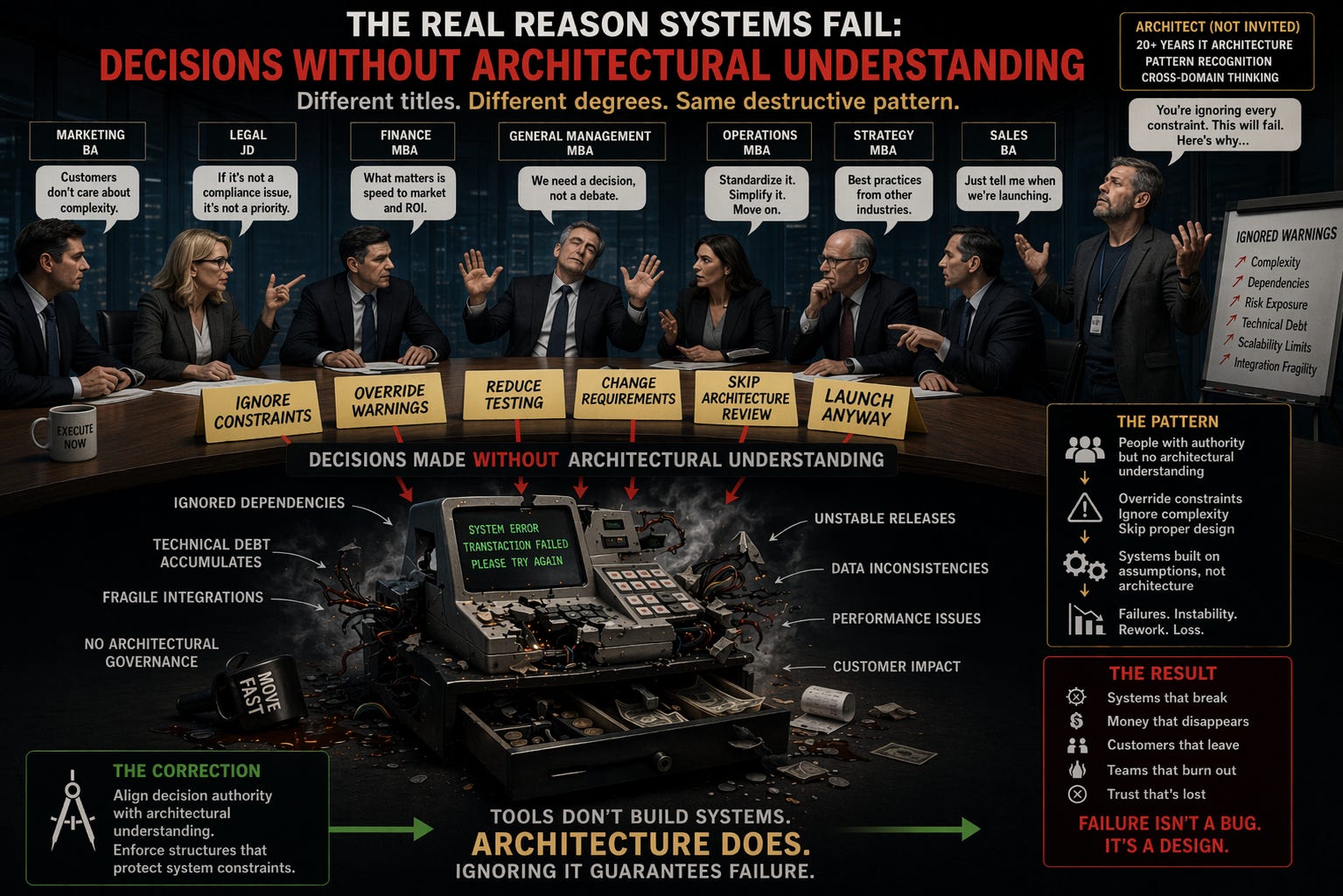
When people who don’t understand the system are the ones deciding how it’s built
By Chris Ciappa
Founder & Chief Coherence Architect
Samirac Partners
Some of the most expensive technical failures in history share the same root cause.
There’s a pattern that shows up over and over again in technical failures.
Different industries. Different technologies. Different decades.
Same outcome.
Not because engineers didn’t know what they were doing.
Not because the tools weren’t good enough.
But because the people making architectural decisions didn’t understand the architecture.
This Isn’t About “Technical vs Non-Technical”
Let’s get something out of the way.
This isn’t:
“non-technical people are the problem”
or “only engineers should lead”
That’s lazy thinking.
The real issue is much more precise:
When decision-making authority exceeds architectural understanding, systems become unstable.
And when that happens consistently enough…
Failure isn’t a possibility.
It’s a trajectory.
The Pattern, Repeated
Healthcare.gov rollout
The goal was simple: launch a national healthcare marketplace.
The reality:
multiple contractors
no unified system architecture
political deadlines overriding technical readiness
Warnings were raised.
They were ignored.
The system launched anyway—and failed immediately under load.
What went wrong?
Not a lack of engineering talent.
👉 Leadership forced execution without understanding the system’s architectural constraints.
Target Canada expansion failure
Target expanded into Canada with a new supply chain and inventory system.
On paper, everything was ready.
In practice:
inventory data was wrong
systems weren’t aligned
shelves were empty
The result:
massive losses
full withdrawal from the country
What went wrong?
👉 Leadership treated a complex system like a spreadsheet rollout—
ignoring the realities of data integrity, system dependencies, and operational flow.
Denver International Airport baggage system failure
A fully automated baggage system was commissioned for a major airport.
Ambitious. Innovative. Impressive.
And completely unworkable.
Bags flew off tracks
Systems jammed constantly
Delays stretched for years
What went wrong?
👉 Leadership pushed for a level of automation that exceeded what the system could realistically support—
ignoring complexity warnings from engineers.
FBI Virtual Case File project failure
A major case management system for the FBI.
$170 million spent
Constant requirement changes
No stable architecture
The system was ultimately scrapped.
What went wrong?
👉 Leadership continuously redefined the system without architectural grounding—
destabilizing it faster than it could be built.
What These Failures Have in Common
These weren’t isolated mistakes.
They share a structural pattern:
Constraints were overridden
Complexity was underestimated
Systems were treated as simpler than they were
Decisions were made without understanding downstream impact
And most importantly:
The system had no protection against bad decisions at the top.
The Real Failure Mode
Most people look at these cases and say:
“bad execution”
“poor project management”
“integration issues”
Those are symptoms.
The deeper issue is this:
Architectural decisions were made by people who didn’t understand the architecture.
That creates a dangerous dynamic:
Engineers raise concerns
Leadership overrides them
Systems are pushed beyond safe limits
And once that loop starts…
Failure becomes inevitable.
Why This Keeps Happening
Because modern tools create the illusion of simplicity.
Dashboards look clean.
Systems feel manageable.
Progress appears visible.
So leadership assumes:
“We understand enough to steer this.”
But they’re not seeing:
hidden dependencies
scaling constraints
state interactions
failure modes
They’re making decisions on the surface…
while the system operates underneath.
This Is Not a People Problem. It’s a Structure Problem.
The issue isn’t that leaders are incapable.
It’s that organizations often lack:
architectural governance
constraint enforcement
mechanisms that prevent invalid decisions from being executed
So the system becomes vulnerable to:
👉 well-intentioned decisions made at the wrong level
The Lesson
You don’t fix this with:
better tools
better prompts
better project plans
You fix it by aligning:
decision authority with architectural understanding
Or by enforcing structures that prevent decisions from violating system constraints in the first place.
Related Reading
Several related articles expand on the broader organizational, architectural, strategic, and cognitive themes discussed here:
Modern IT Architecture: A Structural Perspective
Explores why real architecture is fundamentally structural rather than purely procedural or technological.
When Leadership Lacks Architectural Thinking
Examines what happens when organizational leadership operates without structural systems cognition.
Looks at which forms of cognition and operational capability become more valuable as AI reshapes labor and knowledge work.
The AI Divergent Thinker: Why the Future May Belong to Structural Minds
Explores divergent cognition, systems-level thinking, and why structural minds may become increasingly important in the AI era.
The Ciappa Drift Stack: How My Divergent Thinking Led to Drift Architecture
Connects divergent cognition, architecture, drift theory, and the emergence of the Drift Stack framework.
Explains why organizations consistently underes
These pieces connect structural thinking, organizational drift, leadership cognition, execution behavior, systems architecture, and runtime operational coherence into a broader systems-level framework.
Final Thought
This pattern isn’t new.
It didn’t start with AI.
It didn’t start with cloud.
It didn’t start with modern software.
It’s been happening for decades.
And it will keep happening…
until systems are designed to withstand decisions made by people who don’t fully understand them.
Drift Stack™ & SAQ™ don’t make systems harder to break.
They make certain failures impossible to execute.
The Only Question That Matters
The architecture is already defined.
Drift Stack™ Architecture
https://www.samirac.com/drift-architecture
Now ask yourself:
👉 Does my system control what’s allowed at execution —
or does it just react and hope it gets it right?
Architecture Demos
https://www.samirac.com/daisy-demos
Share This Article
If you found this article valuable, share it.
Substack automatically gives every subscriber a personal referral link. When someone subscribes through your share link, it counts toward referral rewards.
Current rewards:
• 3 referrals → 1 month of paid access
• 5 referrals → 6 months of paid access
• 10 referrals → 12 months of paid access
You can share directly using the Share button on this article, or find your personal referral link here:
By Chris Ciappa
Founder & Chief Coherence Architect
Samirac Partners