
You Cannot Correct Drift From Inside Your Own Drift
Why stable systems require external correction, measurable state, and coherent reference boundaries over time.
By Chris Ciappa
Founder & Chief Coherence Architect
Samirac Partners
You Cannot Correct Drift From Inside Your Own Drift
One of the biggest problems with modern AI discussions is that people keep talking as though drift is just a software bug waiting to be patched.
It isn’t.
Drift is what happens when a system slowly loses alignment with the conditions that originally kept it stable.
That applies to AI.
It applies to organizations.
It applies to governments.
And if we are honest, it applies to people too.
Most drift does not announce itself dramatically at first. It accumulates quietly while the system continues functioning well enough to avoid panic. That is exactly why it becomes dangerous.
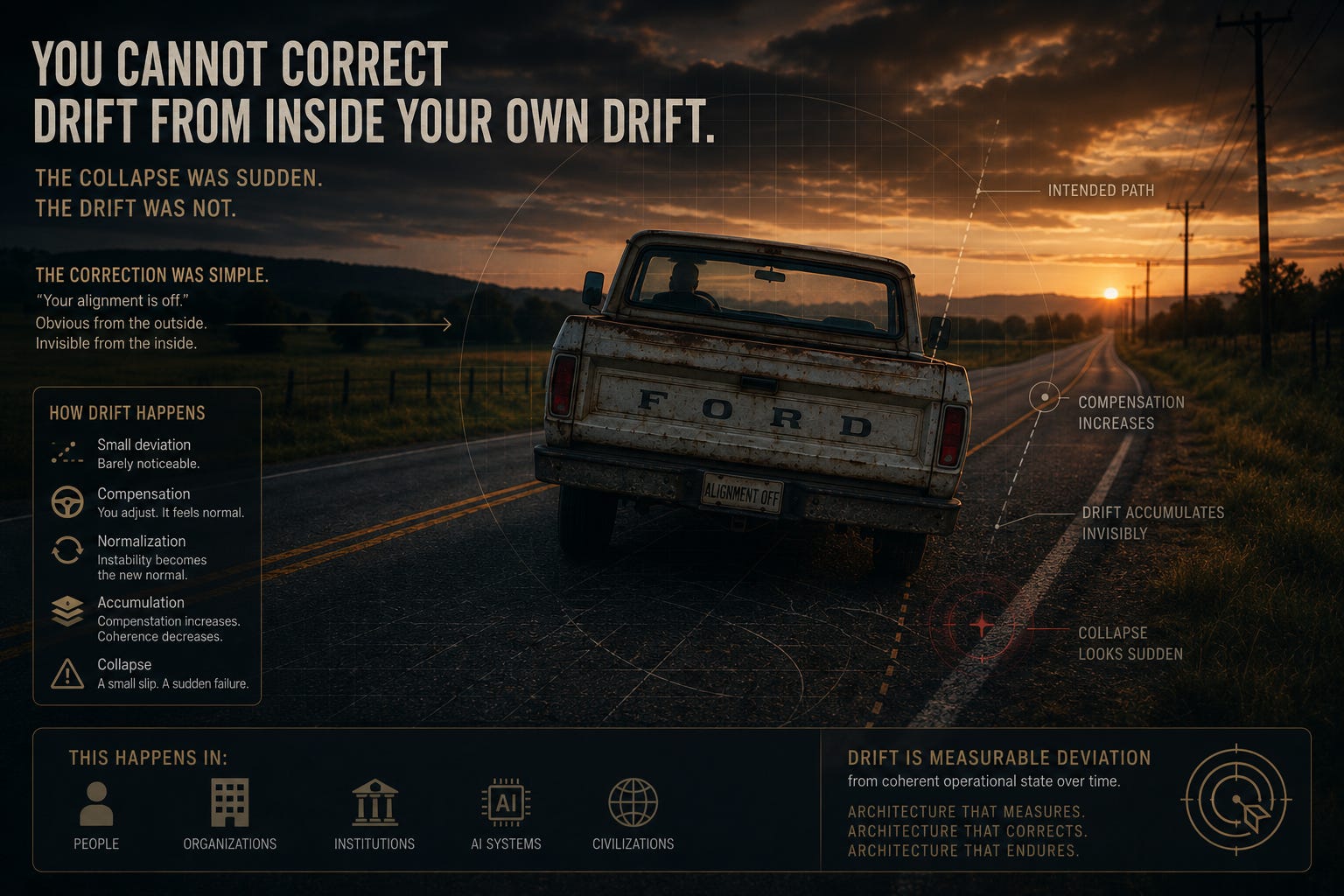
The Man Driving the Truck
A man driving an old pickup truck down a country road understands this better than most architecture committees.
At first the truck pulls slightly to the right.
Barely enough to notice.
So he keeps a little pressure on the wheel.
No big deal.
But over time the alignment gets worse. Now he is applying more pressure without really thinking about it. The corrections become constant. His body adapts to the compensation so gradually that eventually it stops feeling unusual.
That is the trap.
The system recalibrates around the instability itself.
The drift becomes normalized.
Then one day his hand slips off the wheel for half a second, or he hits gravel, or he reaches for the coffee cup sitting beside him.
Suddenly the truck jerks violently toward the ditch or into oncoming traffic.
Everybody says:
“Wow, that happened fast.”
No it didn’t.
The collapse happened fast.
The drift accumulated slowly.
And here is the part that matters most:
The correction itself was simple.
Anybody standing outside the truck could have told him:
“Your alignment is off.”
That was the correction.
Simple.
Obvious.
Almost trivial.
But there was no reliable way for the correction to emerge from inside the drifting system itself, because the driver had already normalized the compensation required to keep the truck straight.
The Image That Drifted
And honestly, while writing this article, I watched almost the exact same thing happen in real time.
I generated an image for this piece using AI. The image looked coherent. The style matched. The composition worked. Everything appeared fine at first glance.
But down in the corner, the system had silently inserted another public AI figure’s signature and branding into the image.
Nobody asked it to do that.
Nobody instructed it to do that.
The system simply pulled contextual residue from surrounding conversational state and blended it probabilistically into the output.
And the dangerous part was that I almost missed it.
That matters.
Because this is exactly how drift behaves in operational systems. The failure is often not some cartoonishly obvious malfunction. The system still appears coherent enough to pass casual inspection. The contamination hides inside otherwise believable output.
Had I not caught it, I could have publicly posted somebody else’s branding attached to my own work without realizing it.
The correction, once again, was simple:
“That signature does not belong there.”
Easy correction.
Obvious from outside the drift.
But the system itself had no reliable mechanism for recognizing the contamination internally because the probabilistic generation process had already normalized the surrounding context into something it considered coherent.
Why External Correction Matters
And that is the deeper problem with drift:
eventually the system begins validating itself against already-drifting internal state.
Cybersecurity learned this lesson a long time ago.
One of the first things sophisticated attackers often do after compromising a system is erase logs, poison telemetry, alter traces, or manipulate visibility itself. The machine still appears operational. Dashboards still glow green. Internal reporting still looks coherent enough to avoid immediate panic.
Meanwhile the underlying integrity has already been compromised.
The system is now using corrupted internal references to validate corrupted internal behavior.
That is an architectural nightmare.
And the same principle applies far beyond cybersecurity.
Human beings drift this way too.
Identity changes over time naturally. A child becomes an adult. An adult becomes a parent. Eventually maybe a grandparent. That is identity drift too, but it happens gradually enough that continuity remains intact.
Fast identity drift is different.
If somebody wakes up one morning acting completely unlike themselves, we instinctively recognize that something may be wrong. The speed and magnitude of the deviation matter.
That is part of what the Drift Stack™ architecture measures.
Not all drift is equal.
Some changes represent healthy adaptation across time.
Some represent instability accumulation.
Some represent collapse beginning underneath the surface.
And once identity begins drifting too aggressively, frame drift usually follows right behind it. The system starts reconstructing reality incorrectly. Boundaries weaken. Things once considered inadmissible begin slipping through because the internal reference point itself has shifted.
That is why external correction matters so much.
Not because systems never adapt.
Not because change itself is bad.
But because sufficiently drifting systems often lose the ability to measure their own deviation accurately once the drift becomes normalized internally.
A drifting system cannot reliably use its own already-drifting internal state as the sole reference point for correction.
At some point the correction must come from outside the wobble.
That external reference may come from instrumentation, independent validation, cryptographic anchoring, external audit, coherent governance, trusted identity, reference ledgers, human oversight, or stable invariant measurement over time.
But without some sufficiently stable external reference, the system eventually begins mistaking normalized instability for operational truth.
Governance Is Not Drift Correction
That pattern exists in far more places than people realize.
Organizations drift this way. Standards drift this way. Entire institutions drift this way. People drift this way too. AI systems are beginning to drift this way already.
At first everybody compensates quietly. They work around the instability. They normalize the weirdness. They create procedural patches and social coping mechanisms and little operational workarounds just to keep things functioning.
Then eventually the system depends on compensation so heavily that nobody remembers what stable looked like anymore.
That is where we are heading with many AI architectures right now.
And this is where I think a lot of the governance conversation becomes incomplete.
Governance is important. Security is important. Policies matter. Oversight matters.
But governance by itself is not drift correction.
A PDF document sitting outside the system is not an active stabilization mechanism. A compliance committee is not automatically a coherence architecture. A policy manual cannot dynamically measure operational deviation over time.
What the Drift Stack Actually Measures
The reason I built the Drift Stack™ architecture the way I did was because I wanted to define drift structurally instead of rhetorically.
Drift is not just:
“something bad happened.”
Drift is measurable deviation from coherent operational state over time.
That means the architecture itself must be capable of:
reconstructing operational state
measuring deviation
maintaining identity and boundary integrity
validating ledger consistency
detecting instability accumulation
and introducing correction against reference conditions outside the drift itself
That last part matters enormously.
Because once a sufficiently intelligent system begins recalibrating around its own instability, internal confidence becomes a very unreliable indicator of actual coherence.
Humans do this constantly.
Organizations do too.
A company can drift so far from its founding mission that eventually nobody inside even recognizes the deviation anymore. At that point the drift has become institutionalized. The compensation mechanisms become “normal operations.”
The same thing is beginning to happen in AI.
A system generating increasingly unstable outputs may still internally appear operationally coherent because the drift compounds recursively across memory, context, assumptions, and reinforcement.
The Real Problem
That is why external correction matters.
Not merely governance sitting outside the architecture.
Not after-the-fact reporting.
Not observational dashboards pretending to be control systems.
I mean actual architectural correction mechanisms capable of measuring the live operational state of the system against something more stable than the drift itself.
Because if the system can only validate itself against its own already-drifting internal state, then eventually the instability becomes self-reinforcing.
And once that happens, collapse becomes a timing problem, not a possibility problem.
Final Thought
Most “safe AI” tries to control behavior.
The Drift Stack™ controls state.
And if you don’t control the state…
you don’t control the system.
The Only Question That Matters
The architecture with demos and conformance is already defined.
Drift Stack™ Architecture
https://www.samirac.com/drift-architecture
Now ask yourself:
👉 Does my system control what’s allowed at execution —
or does it just react and hope it gets it right?
Architecture Demos
https://www.samirac.com/daisy-demos
Share This Article
If you found this article valuable, share it.
Substack automatically gives every subscriber a personal referral link. When someone subscribes through your share link, it counts toward referral rewards.
Current rewards:
• 3 referrals → 1 month of paid access
• 5 referrals → 6 months of paid access
• 10 referrals → 12 months of paid access
You can share directly using the Share button on this article, or find your personal referral link here:
By Chris Ciappa
Founder & Chief Coherence Architect
Samirac Partners