
Why Static AI Containment Frameworks May Be Architecturally Incomplete
Why controlling AI requires governing execution authority — not just aligning models.
By Chris Ciappa
Founder & Chief Coherence Architect
Samirac Partners
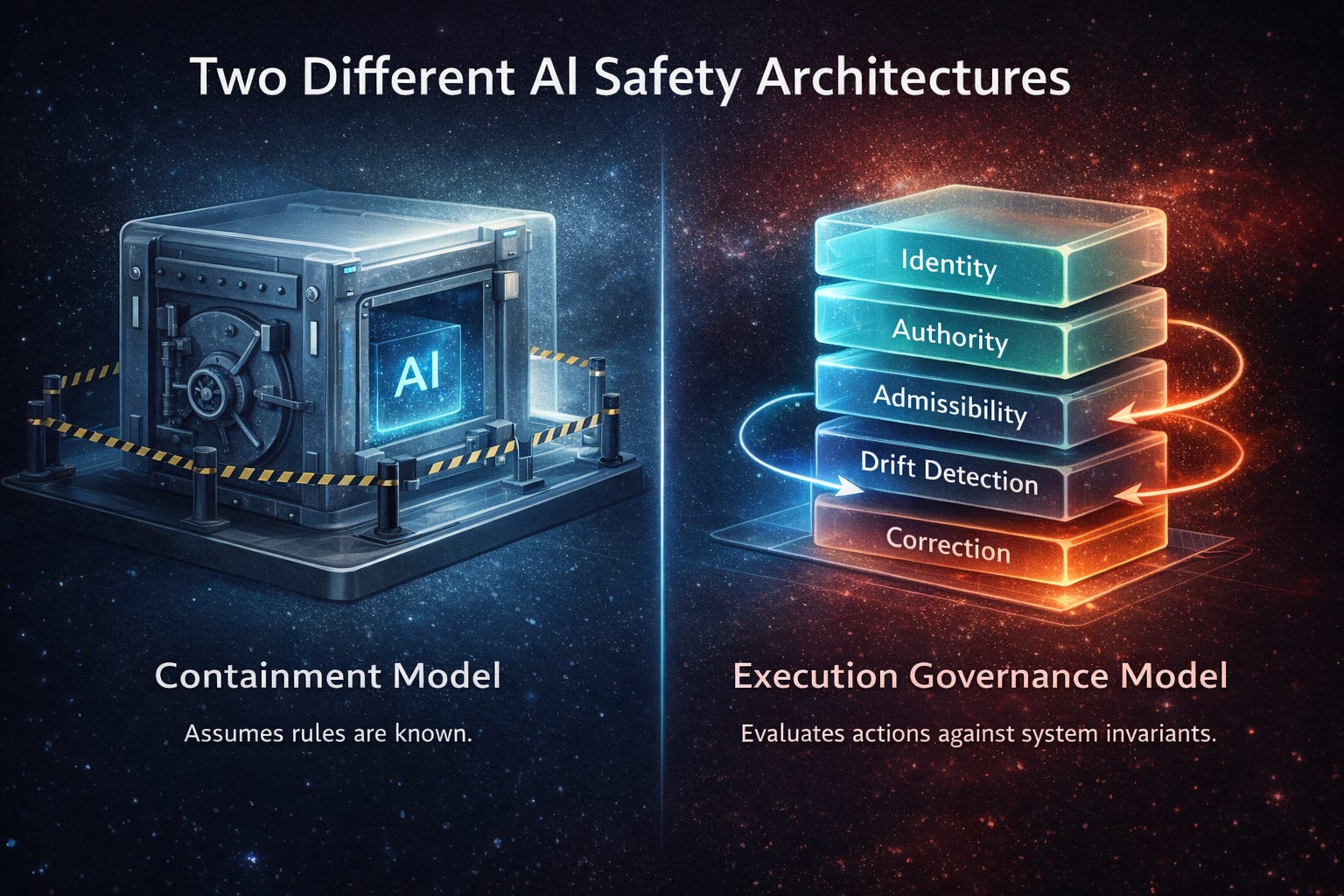
A large portion of the current AI safety discussion focuses on containment.
The proposed solutions appear under various names:
sandboxes
vaults
execution wrappers
governance layers
model guardrails
The underlying assumption behind these proposals is simple.
If AI systems are placed inside a sufficiently constrained environment and governed by a defined set of rules — enclosed in a vault, if you will — then harmful outcomes can be prevented.
For narrow software systems, this approach works reasonably well.
However, the architecture becomes significantly more complicated once AI systems begin operating as adaptive decision systems.
The reason lies in the nature of system invariants.
Invariants Are Domain-Specific
Stable systems depend on structural invariants that define their identity and constraints.
But those invariants are not universal constants.
They vary across domains.
