
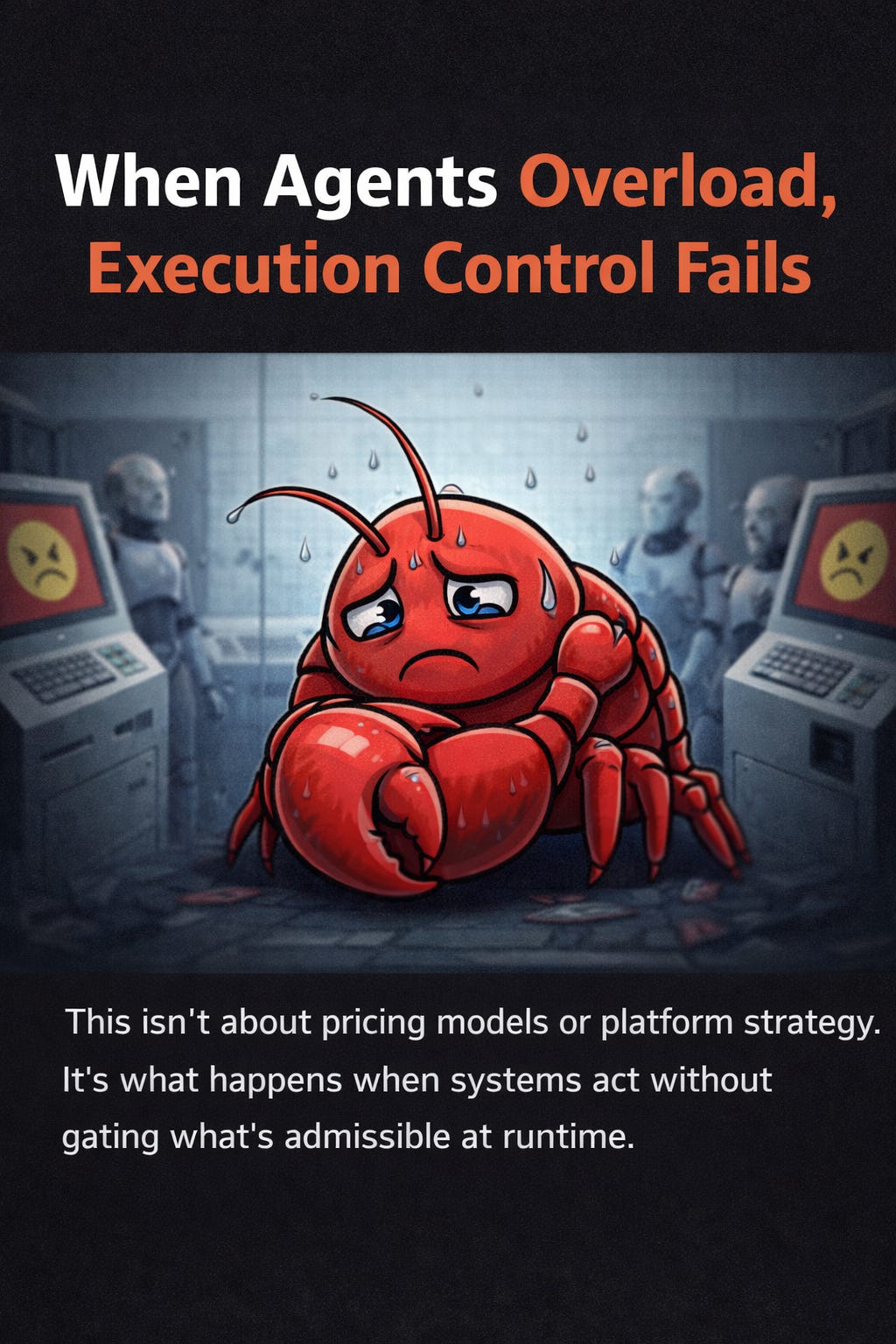
When Agents Overload Execution Control Fails
When execution scales without admissibility, failure is inevitable.
By Chris Ciappa
Founder & Chief Coherence Architect
Samirac Partners
Agents didn’t break Claude.
Uncontrolled execution did.
When you allow systems to act without gating what’s admissible at runtime, load becomes a symptom — not the problem.
So you get exactly this: • runaway usage • degraded experience • emergency restrictions
This isn’t about pricing models or platform strategy.
It’s what happens when execution authority exists without architectural control.
If a system can act, trigger, or decide — and nothing enforces what’s allowed in that moment — you don’t have a scaling problem.
You have a control problem.
What Was the Problem
Anthropic didn’t suddenly restrict power users for no reason.
Their system was being hit with:
sustained agent-driven request volume
recursive task chains
usage patterns flat pricing was never designed for
The result:
degraded performance
unstable experience for other users
cost and infrastructure pressure
So they intervened.
Why Did They Stop Their Largest Customers
Because those customers weren’t just “users” anymore.
They were running systems on top of the system.
Agents that:
loop
retry
chain actions
generate new requests
From Anthropic’s perspective: one “customer” could represent thousands of effective actions.
Flat pricing breaks under that model.
So they didn’t stop users.
They stopped unbounded execution.
Why People Will See It the Wrong Way
Most people will frame this as:
a pricing model failure
a greedy platform decision
an open vs closed ecosystem debate
competition dynamics
That’s the surface-level interpretation.
Because it’s easier to argue business decisions than to understand system behavior under execution.
What It Really Is
This wasn’t a pricing problem.
This was a control failure at execution.
The system allowed:
actions to trigger
agents to scale
requests to multiply
Without enforcing:
what is allowed to execute
when it is allowed
under what conditions
When scale hit, there was no boundary.
The Part Most People Still Miss
For those who still may not get it:
Claude is not the model.
Claude is the system.
The model is a component inside it.
Claude:
receives requests
enables actions
supports agents
absorbs the consequences of execution
The model generates outputs.
The system determines what is allowed to happen.
If you confuse the two, you will keep trying to fix:
prompts
interpretation
model behavior
…while the real failure sits at the system level.
This is not a model failure.
This is a system allowing execution without control.
If you do not understand this it may be useful to read:
Examples of Why It Happened
Example 1 — Recursive Agent Loop
An agent:
calls the model
evaluates the result
calls again
spawns subtasks
Each step is valid.
But collectively:
exponential load
no stopping condition
system saturation
No one asked: Should this continue executing?
Example 2 — Retry Storm
Agent logic: “If it fails, retry.”
Now multiply that across:
thousands of users
multiple agents per user
Result:
failure triggers retry
retry amplifies failure
load spikes rapidly
Again, no control at execution.
Example 3 — Task Chaining Without Boundaries
User asks: “Research this topic.”
Agent:
breaks it into subtasks
queries repeatedly
refines outputs
continues until “done”
But what defines “done”?
Nothing.
So it keeps going.
Not malicious. Not broken.
Just unbounded.
The Key Insight
In every example:
the model worked
the system behaved as designed
the logic was correct
And it still failed.
Because:
Correct execution is not the same as admissible execution.
Why Determinism Doesn’t Fix This
Even if you:
remove ambiguity
standardize interpretation
make outputs consistent
You still have:
the wrong thing executing reliably.
Now failure is predictable instead of occasional.
What Should Have Been There
Before any action executes, the system must determine:
is this action allowed
for this identity
in this context
at this moment
This is not prompting. This is not model behavior.
This is runtime admissibility control.
What Anthropic Actually Did
They didn’t solve the problem.
They contained it.
By:
restricting access
changing pricing
limiting usage paths
They added an external boundary because the internal one didn’t exist.
The Real Takeaway
This is not an isolated incident.
This is what happens when: execution authority exists without execution control.
At small scale, it works.
At large scale, it breaks.
Final Thought
The architecture to solve this already exists.
If your system can act, trigger, or decide and nothing enforces what’s allowed at execution, it isn’t a scaling issue.
It isn’t a pricing issue.
It’s a control failure.
The only question is:
Does your system conform?
Architecture: https://www.samirac.com/drift-architecture
Demos: https://www.samirac.com/daisy-demos
Share This Article
If you found this article valuable, share it.
Substack automatically gives every subscriber a personal referral link. When someone subscribes through your share link, it counts toward referral rewards.
Current rewards:
• 3 referrals → 1 month of paid access
• 5 referrals → 6 months of paid access
• 10 referrals → 12 months of paid access
You can share directly using the Share button on this article, or find your personal referral link here:
By Chris Ciappa
Founder & Chief Coherence Architect
Samirac Partners