
What Is Drift?
The simple 5 letter word that can make or break entire industries and societies.

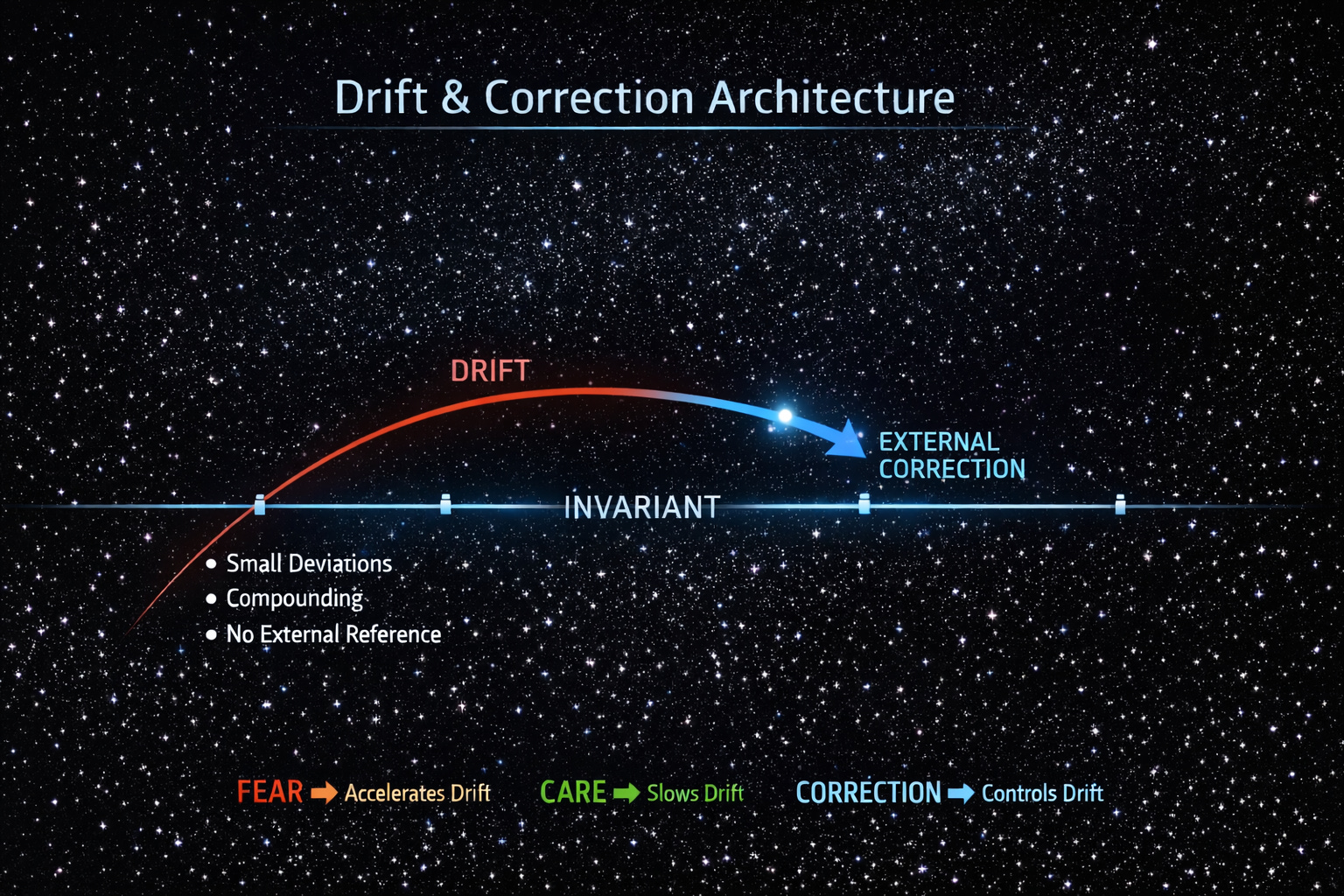
Drift isn’t chaos.
Drift is slow misalignment.
Entire industries fail this way.
It’s what happens when small deviations compound because no one corrects them.
Here’s the simple version.
An invariant is like a fence post.
If you’re running a straight fence line across a field, you don’t eyeball it from the last board you nailed in.
You anchor to the fence post.
It doesn’t move.
It doesn’t argue.
It doesn’t adjust to your feelings.
It just stands there and keeps the line straight.
Now imagine you start adjusting each new board slightly off the last one.
Just a little.
Not noticeable at first.
After a mile?
Your fence ends up in your neighbor’s pond.
That’s drift.
Nobody sabotaged the fence.
Nobody burned it down.
It just slowly walked off the line because the anchor stopped being used.
Drift happens in systems the same way.
You relax standards “just this once.”
You centralize control “just temporarily.”
You suppress dissent “for stability.”
Small deviations.
Compounding.
No fence post.
Eventually the whole structure looks intact —
but it’s no longer aligned with its purpose.
That’s drift.
Drift doesn’t explode.
It accumulates.
And most collapses aren’t sudden.
They’re just fences that walked off the line for too long.
You Can See Drift Everywhere
You can see drift everywhere if you know what to look for.
In aviation, small checklist deviations become routine.
A skipped confirmation.
An assumed callout.
Nothing dramatic — until the margin disappears.
In medicine, standards bend under pressure.
Protocols become suggestions.
Documentation becomes habit.
Outcomes slowly separate from intent.
In epidemiology, models harden into certainty.
Uncertainty narrows.
Dissent thins out.
Policy moves faster than correction.
In markets, long periods of calm disguise growing risk.
Leverage creeps up.
Assumptions compound.
Then one shock reveals how far off the line things moved.
In every case, no one intended collapse.
The fence just walked.
Fear Accelerates Drift
Now here’s where fear comes in.
Fear speeds drift.
When people feel threatened:
They centralize control.
They shorten time horizons.
They narrow feedback.
They protect ego over truth.
Short term? Efficient.
Long term? Crooked fence.
Care Slows Drift
Care slows drift.
Care says:
Keep the post.
Preserve dignity.
Allow correction.
Stay aligned to the original line.
Care isn’t softness.
It’s alignment discipline.
Drift Requires External Correction
But here’s the part most people miss:
Drift cannot be reliably corrected from inside the same system that is drifting.
If you’re standing in the field adjusting boards off the last crooked board, you can’t see the deviation anymore.
You need something outside the line.
A string pulled tight.
A survey marker.
A reference that isn’t moving with you.
Correction must sit outside the loop.
Independent.
Non-aligned to immediate incentives.
Able to say: “That’s off the line.”
Without that, drift becomes normal.
The new crooked line feels straight.
Without correction, the fence walks.
In aviation, when an aircraft loses reliable guidance and drifts off course, it doesn’t self-correct by intention.
It corrects when an external signal — tower, instrument cross-check, ground reference — re-anchors it to the line.
Without that? Drift continues until fuel runs out or something breaks.
In medicine, if treatment protocols drift and no independent review catches it, harm compounds quietly.
It corrects when audit, peer review, or external standards intervene.
Without that? The new deviation becomes normal practice.
In markets, when risk models drift and leverage builds unchecked, correction doesn’t come from inside the bubble.
It comes from external shock or regulatory constraint.
Without that? The line keeps bending.
The Outlier: AI
Now move to AI.
AI is different.
AI systems can act at scale, adapt at speed, and influence decisions across domains — while drifting internally in ways that are not always visible.
When AI systems are given execution authority — to decide, deny, trigger, approve, enforce — drift is no longer slow.
It compounds.
At machine speed.
Without external correction, AI doesn’t just drift.
It scales drift.
AI doesn’t “figure it out.”
It keeps moving.
And unlike a crooked fence, AI systems can act in the real world while drifting.
That’s the difference.
The question isn’t whether drift exists.
It’s whether correction exists.
Drift is inevitable. You don’t “prevent” it — you control it with external correction.
Take the Assessment
Chris Ciappa
Samirac Partners
Coherence Architect
Drift • Correction • Execution Authority