
The Herd Moves Together
Drift, Swarm State, and Multi-Agent AI
By Chris Ciappa
Founder & Chief Coherence Architect
Samirac Partners
How do you maintain operational coherence once multiple interacting agents begin influencing each other under changing conditions?
That is a very different problem than simple orchestration.
And honestly, the more I think about it, the less this even feels like a software problem alone. It feels more like watching animals on a farm.
Anybody who has spent time around horses, cattle, or even chickens understands this instinctively. You can often feel when the state of the herd changes before you can fully explain why. One horse lifts its head. Another shifts nervously. A few begin moving differently, and suddenly the entire field feels tense.
One animal gets spooked and now everything around it begins reacting.
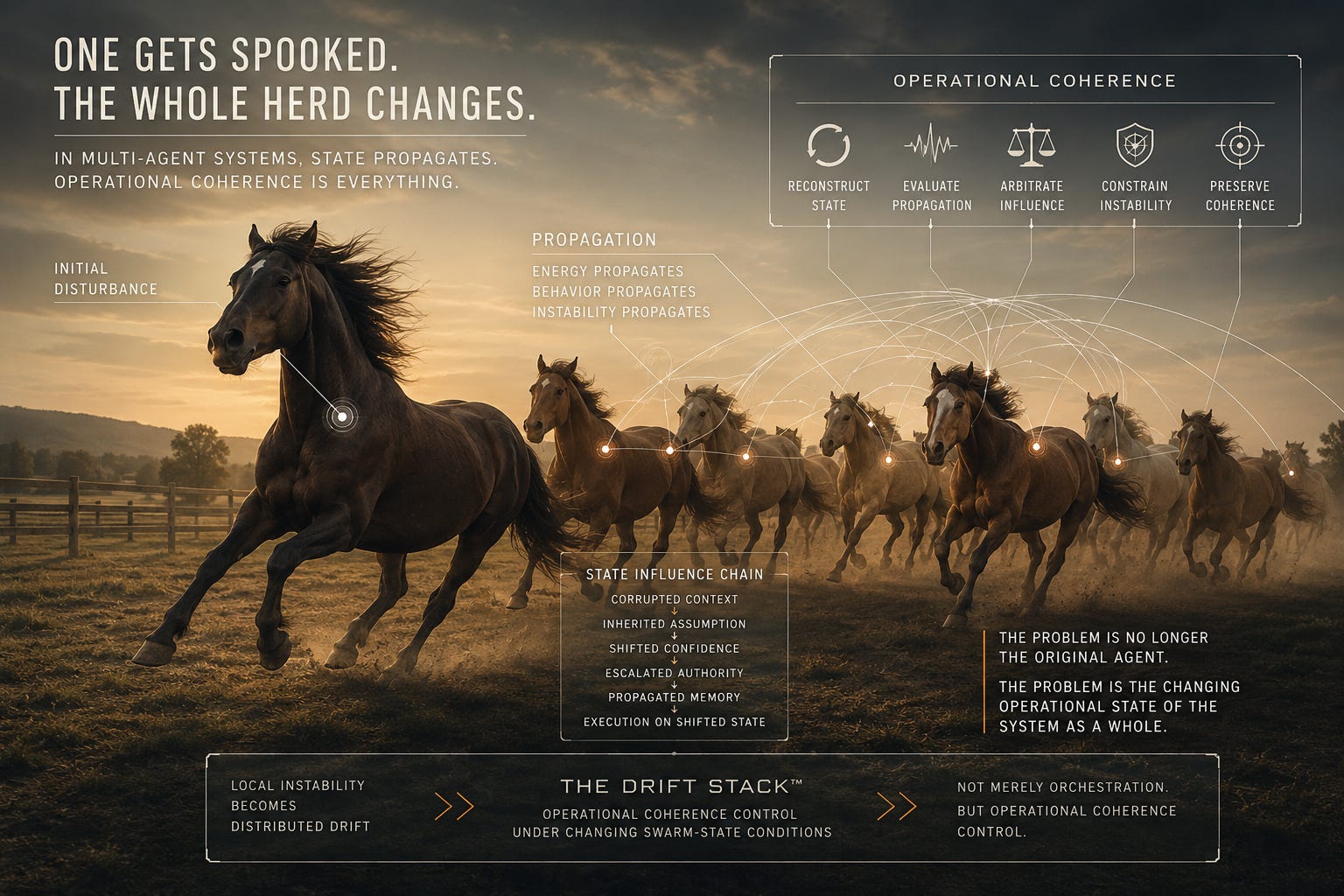
Not independently anymore, but collectively. One reacts to another, which triggers reactions in the rest of the herd, and before long the entire herd is reacting to itself. Energy propagates. Behavior propagates. Instability propagates.
And good farmers learn something important very early: if you do not contain that propagation quickly, the environment itself changes. The problem is no longer the original animal. The problem becomes the changing operational state of the herd as a whole.
Oddly enough, I think large-scale AI systems are beginning to resemble this far more than most software people currently realize.
Because once multiple agents begin interacting continuously under changing conditions, the system itself starts developing swarm-state behavior. One agent receives corrupted context, another quietly inherits the assumption, and before long a third begins adjusting confidence weighting based on already-shifted conditions. Another escalates authority. Another propagates altered memory state. Another executes against operational conditions that may no longer even be valid.
By the time anyone notices the visible failure, the system may have already drifted several layers away from the state that originally existed.
That distinction matters enormously.
Most current conversations around multi-agent systems still revolve around orchestration, memory-sharing, routing layers, unified graphs, vector synchronization, or substrate convergence. Those are legitimate engineering concerns. But I believe the deeper problem sits elsewhere.
The harder challenge is maintaining operational coherence while the agents continuously influence one another over time.
That is where systems start becoming less like isolated software components and more like living operational environments. Assumptions propagate. Context propagates. Confidence propagates. Authority propagates. And once enough interacting components begin influencing one another simultaneously, local instability can quickly become distributed drift.
Years ago, long before the current AI wave, I learned similar lessons building large-scale operational systems across finance, healthcare, hospitality, manufacturing, and enterprise environments. One of the biggest lessons was that large systems rarely fail all at once. They drift gradually as assumptions diverge, definitions shift, dependencies propagate, and local inconsistencies spread into broader operational instability.
Usually the visible failure appears far away from where the original instability actually started.
That is one reason I believe the industry is still underestimating the importance of operational-state reconstruction and admissibility at the execution boundary itself.
People keep asking:
“How do we connect the agents?”
I think the deeper question is:
“How do we continuously reconstruct and evaluate the operational state of the broader system before authority is allowed to propagate further?”
Because once you begin viewing the problem structurally instead of cosmetically, something important becomes visible. The same underlying dynamics appear everywhere:
inside conversational systems,
inside enterprise workflows,
inside distributed operational environments,
inside financial systems,
inside organizations,
and increasingly inside multi-agent AI swarms.
The scale changes.
The structural problem does not.
The system must continuously reconstruct operational state and evaluate how instability is propagating through the environment. It must arbitrate influence, constrain escalation, and preserve coherence under changing conditions. Otherwise local instability becomes distributed drift.
That, to me, the Drift Stack™ architecture starts becoming quite important here.
Not merely as orchestration.
But as operational coherence control under changing swarm-state conditions.
The Only Question That Matters
The architecture is already defined.
Drift Stack™ Architecture
https://www.samirac.com/drift-architecture
The only question is:
👉 Does your system control what’s allowed at execution—
and is it safe, or does it just react and hope it gets it right?
Architecture Demos
https://www.samirac.com/daisy-demos
Share This Article
If you found this article valuable, share it.
Substack automatically gives every subscriber a personal referral link. When someone subscribes through your share link, it counts toward referral rewards.
Current rewards:
• 3 referrals → 1 month of paid access
• 5 referrals → 6 months of paid access
• 10 referrals → 12 months of paid access
You can share directly using the Share button on this article, or find your personal referral link here:
By Chris Ciappa
Founder & Chief Coherence Architect
Samirac Partners