
The Digital Collar (DCD) - A Decentralized Asset-Backed Reserve Currency
A Constitutional Alternative to CBDCs

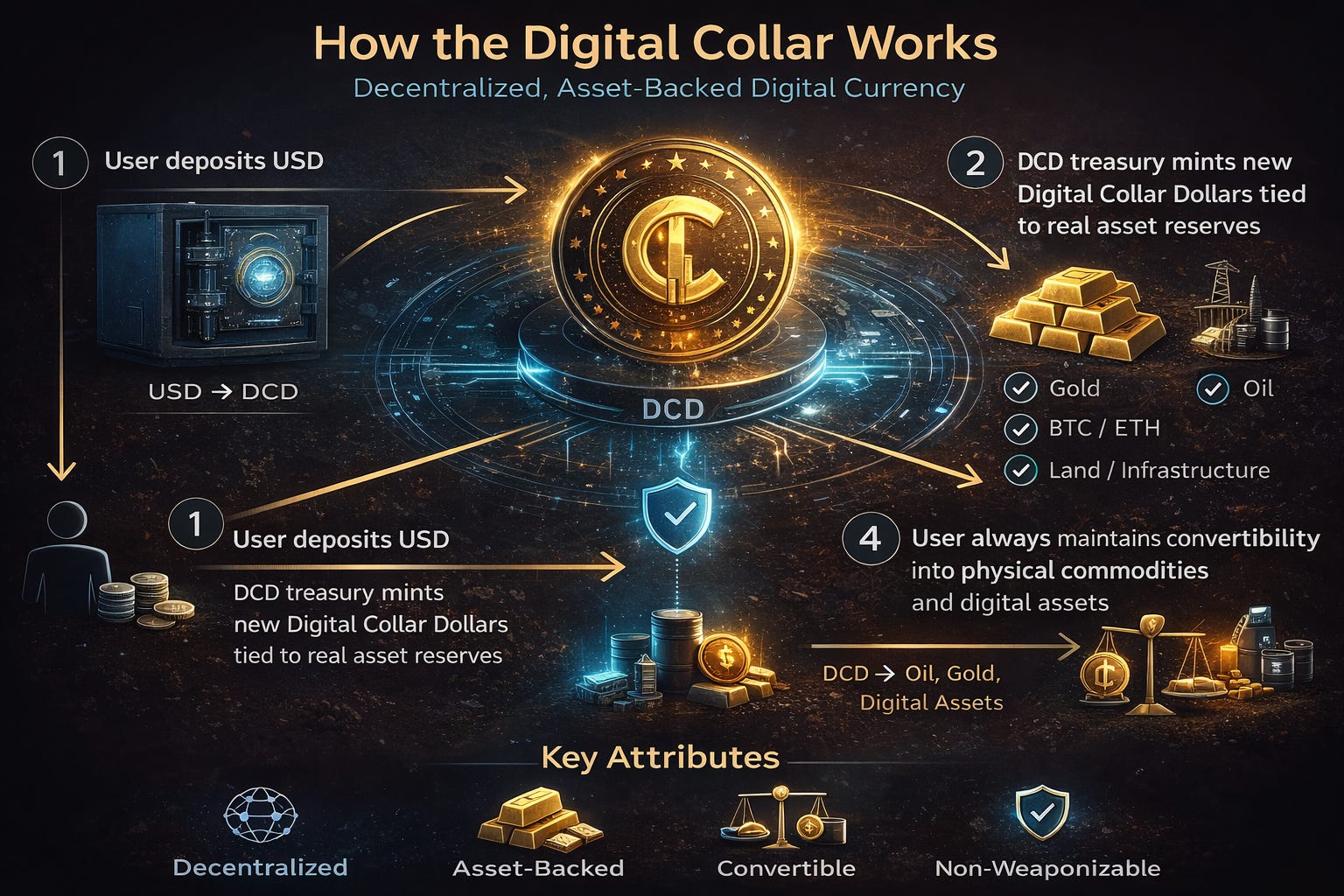
Over a year ago, I drafted and submitted a proposal outlining a decentralized, asset-backed alternative to Central Bank Digital Currencies (CBDCs).
The goal was simple: preserve monetary stability without granting the state transaction-level control, surveillance authority, or coercive policy leverage.
That proposal — the Digital Collar (DCD) — was sent to the U.S. Treasury and the White House Office of Science and Technology Policy. It was not a protest. It was a design — architecture in a pattern that works.
In recent months, new systems and frameworks have begun to surface publicly that echo many of the same architectural constraints under different names. That convergence is not surprising. The underlying problems are structural, not ideological.
What follows is the original proposal, published here for the record.
This mirrors the original dated emailed PDF that was sent 7/24/2025.
And yes, the ledger will need to implement Secure Against Quantum (SAQ™) and conform to certification of same.
Executive Summary
The Digital Collar Dollar (DCD) is a bold proposal to reimagine the U.S. dollar as a decentralized, asset-backed digital reserve currency—one that restores economic trust, ends inflationary abuse, and eliminates the risk of government overreach.
Unlike Central Bank Digital Currencies (CBDCs), which concentrate power and surveillance, the DCD is structured for long-term sovereignty and purchasing power protection. It is backed by tangible U.S.-controlled assets—natural resources, infrastructure, and digital commodities—and governed through a transparent, democratic, and immutable blockchain framework.
This initiative offers a real solution to fiat instability by embedding hardcoded limits, individual financial protections, and convertibility into physical commodities like oil, gold, and Bitcoin. DCD is designed to protect citizens, not control them.
As America faces a pivotal economic crossroads, the Digital Collar offers a third path: not unregulated chaos, nor authoritarian control—but sound, accountable, liberty-focused currency reform.
Introduction: A Moment of Truth
The global monetary system is at a breaking point. Inflation continues to erode savings, reckless monetary expansion devalues hard-earned money, and centralized control threatens financial sovereignty. The United States, once the undisputed leader in sound money principles, now faces a pivotal decision: Continue down the path of unsustainable fiat policies or embrace a revolutionary alternative that ensures stability, security, and economic prosperity for generations to come.
That alternative is the Digital Collar (DCD)—a decentralized, asset-backed digital currency that eliminates government manipulation, protects purchasing power, and reinforces America’s financial dominance in the world.
This document outlines exactly how DCD works, why it is superior, and how it phases in with minimal disruption while maximizing benefits. If you believe in economic stability, individual freedom, and a stronger nation, then DCD is the only logical choice.
What Problems Does This Solve?
The Digital Collar Dollar (DCD) is designed to fix the fundamental flaws in both fiat money and centralized digital currencies. Here’s what it solves:
🔥 1. Fiat Devaluation
Fiat currencies can be printed endlessly, eroding savings and destroying trust.
✅ DCD is backed by hard assets, which cannot be arbitrarily inflated.
🧠 2. Reckless Monetary Expansion
Central banks have no constraints, fueling asset bubbles and inequality.
✅ DCD enforces discipline by tying currency supply to real-world value.
🔍 3. Government Overreach
CBDCs allow financial surveillance and political weaponization.
✅ DCD removes centralized control and enshrines individual protections.
🌍 4. Loss of Global Dollar Demand
As confidence in fiat fades, nations look for alternatives.
✅ DCD makes the dollar attractive again through scarcity, transparency, and convertibility.
📈 5. Inflation Hedging
Current options (gold, Bitcoin) are volatile or inaccessible.
✅ DCD auto-tracks commodity value, preserving purchasing power over time.
⚠️ 6. Peg Failure Risk
Historical pegs broke under pressure due to weak backing or manipulation.
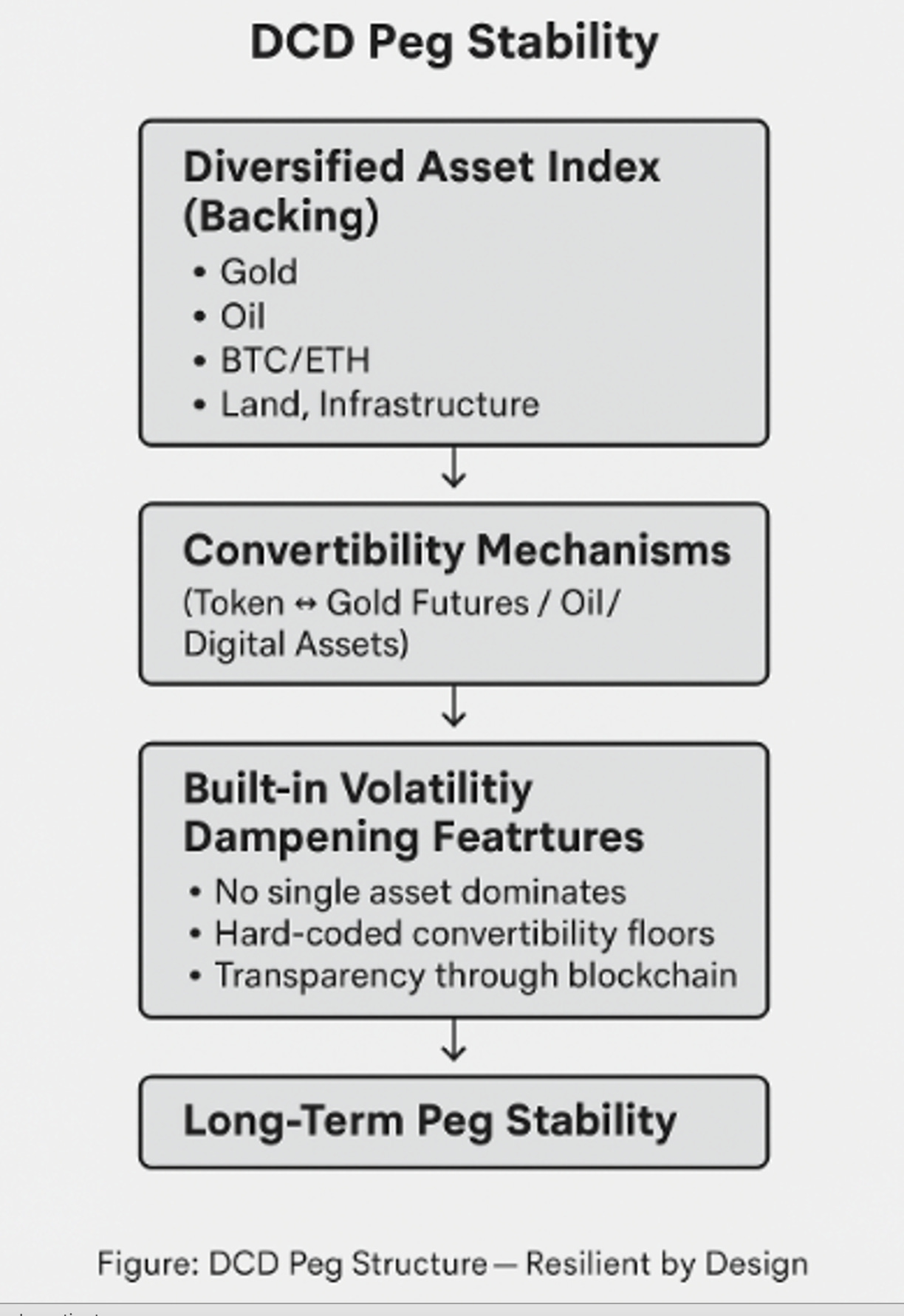
✅ DCD includes enforced convertibility, transparency, and Monte Carlo-tested reserves to keep its peg strong.
Monte Carlo Simulation and Risk Reduction
A Monte Carlo simulation was conducted to assess different financial stability scenarios under DCD. The results confirm:
Successful Peg (Stable Scenario) – USD appreciates gradually as the Digital Collar stabilizes, supporting long-term confidence.
Volatile Adjustment (Medium Risk) – The system experiences temporary price fluctuations but ultimately stabilizes as markets adjust.
Loss of Trust (Peg Breaks, High Risk) – The highest-risk scenario, which has historically plagued fiat and past pegs, is all but eliminated through DCD’s asset-backed framework and enforced convertibility rules and blockchain rules and immutability.
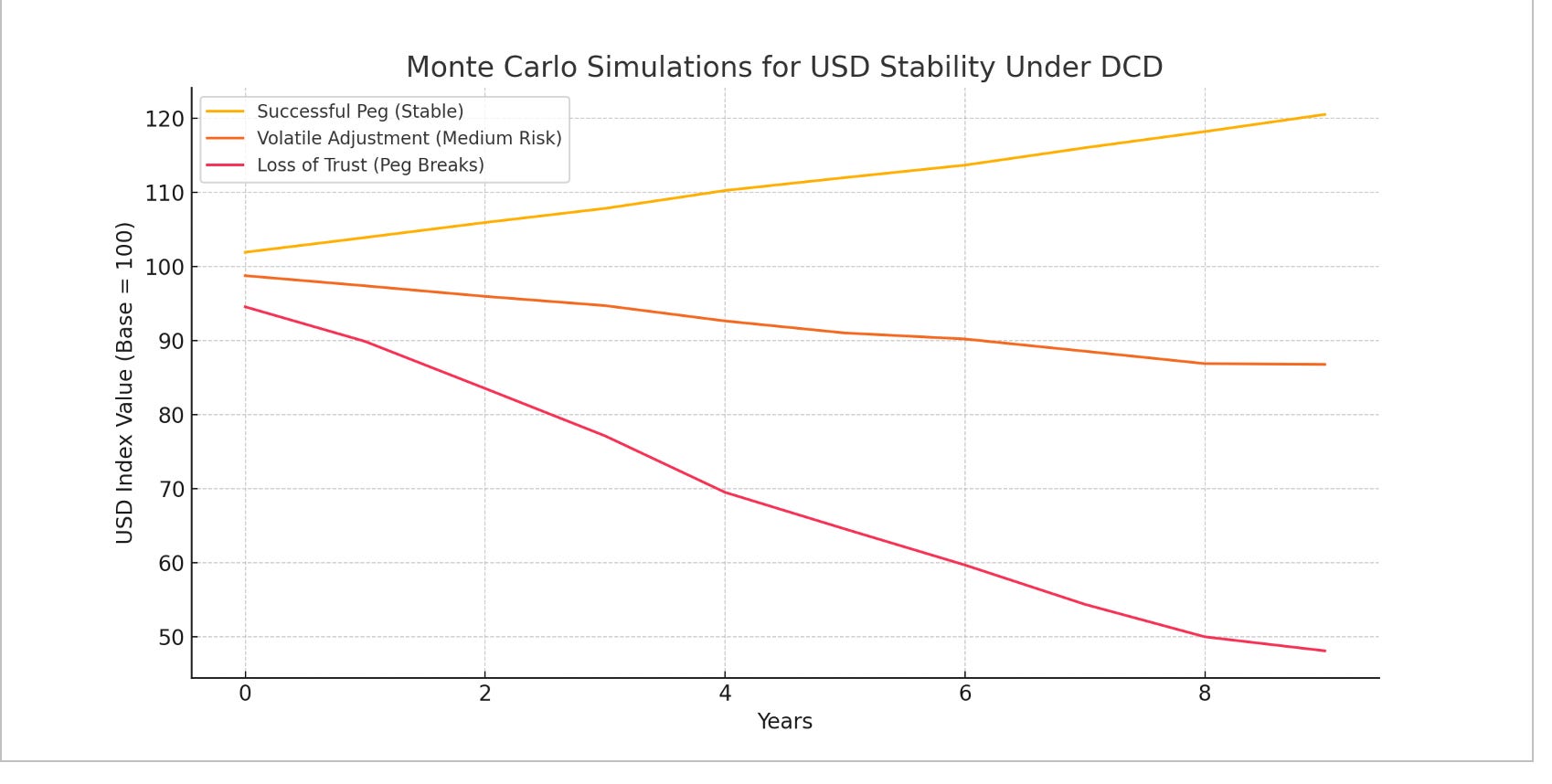
These findings reinforce that our approach prioritizes risk mitigation and stability while preventing currency debasement.
How Would the Digital Collar Work?
What is the Digital Collar?
The Digital Collar (DCD) is not just another digital currency—it is the first decentralized, asset-backed digital reserve currency designed to ensure that money cannot be inflated away, manipulated, or controlled by any government or corporate entity. Unlike traditional fiat money, which can be printed endlessly, or Central Bank Digital Currencies (CBDCs), which give governments total financial surveillance and control, DCD is pegged to real, hard assets like gold, oil, and Bitcoin.
DCD is engineered to provide permanent purchasing power protection, financial sovereignty, and a stable monetary system immune to political interference. It exists to restore trust in money by making sure that every unit of currency remains fully backed by tangible reserves.
Instead of a Central Bank Digital Currency (CBDC) (which is centralized and controllable), the Digital Collar (DCD) would be:
Decentralized – No single entity controls issuance beyond initial setup.
Asset-backed – Each unit is backed by a U.S.-determined index of commodities and digital assets.
Convertible – Holders can redeem for:
Micro mini oil futures
Gold futures
Digital assets (BTC, ETH, others)
Paper & Digital Coexistence – The Digital Collar would be exchangeable for cash dollars, maintaining physical money as an option.
Asset-Backed Stability: The Role of Land, Infrastructure, and Natural Resources
In addition to traditional monetary assets like gold, oil, and digital reserves, DCD will be collateralized by high-value, income-generating U.S. assets, ensuring long-term stability and growth:
Government-Owned Land & Infrastructure – Select portions of federally owned land, ports, and strategic assets can serve as collateral, ensuring real intrinsic value backing the currency.
Revenue-Producing Assets – Toll roads, major energy reserves, and critical infrastructure could be included in the reserve pool, reinforcing stability without requiring asset liquidation.
Tokenized Lease Rights – Instead of outright sales of public assets, tokenized leasing mechanisms can ensure steady revenue streams backing the currency without compromising U.S. sovereignty.
Commodity Reserves – The U.S. holds vast reserves of natural resources, from energy (oil, natural gas) to agriculture and minerals, which can provide further long-term collateral for DCD issuance.
This approach ensures that DCD is not just backed by volatile assets but by real, productive, and income-generating components of the U.S. economy.
Ensuring Fair and Secure Governance
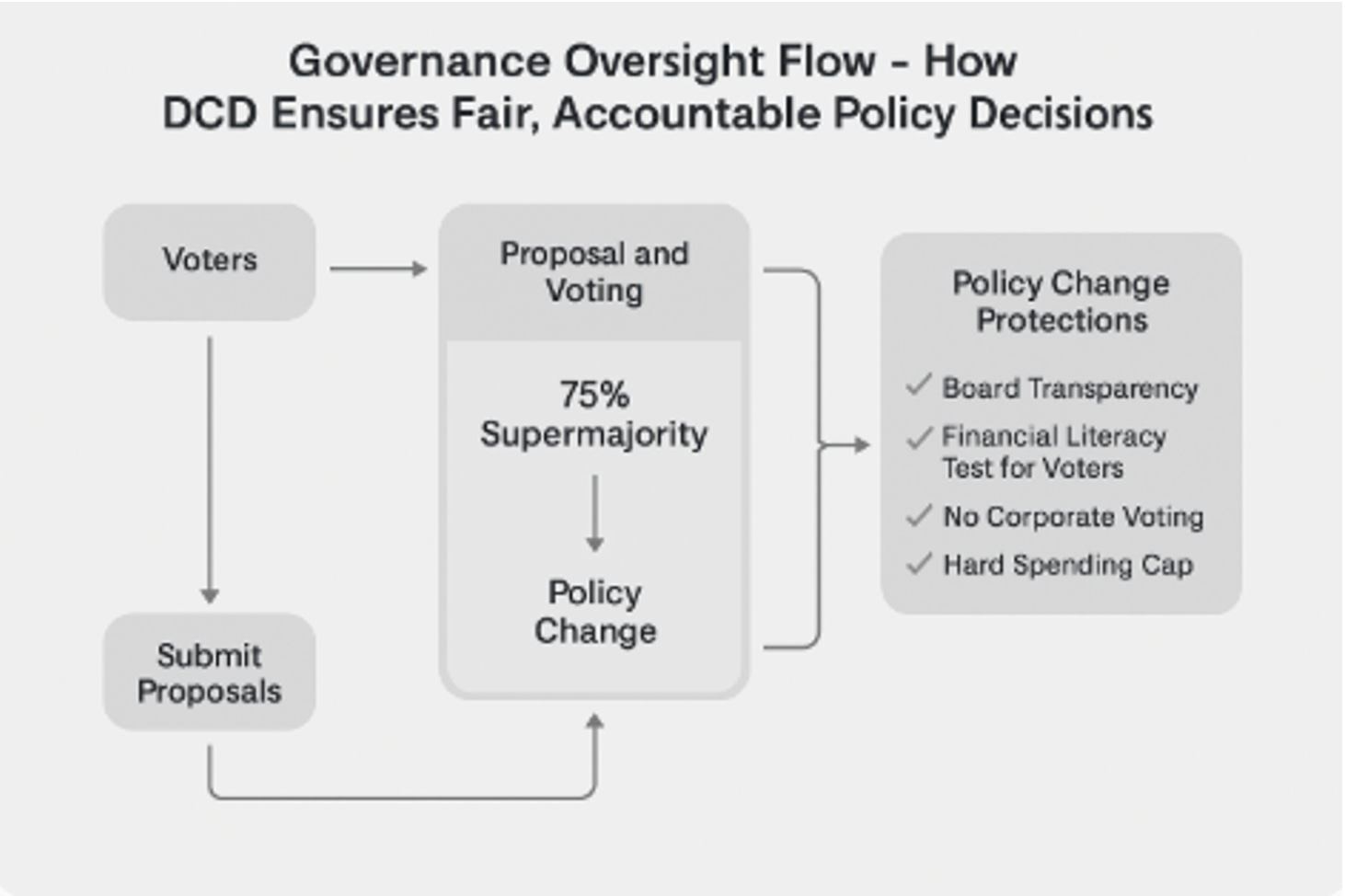
Unlike traditional financial systems where the wealthiest individuals or corporations dictate policy, DCD implements a truly democratic financial governance system:
Voting power is capped per individual – No single person can control excessive influence, ensuring fair participation.
Corporate funds and individual funds are strictly separated – Only individual holders of DCD may vote, preventing corporate takeovers.
Financial literacy test required for voters – This ensures only those who understand economic principles can vote on monetary policy.
Elected board members must publicly post their proposals, participate in live debates, and undergo blockchain-recorded interviews – Ensuring full transparency and accountability.
Hardcoded spending limits – No elected body can ever approve spending beyond the total backing assets available, guaranteeing monetary stability for all time.
Major policy changes require a public referendum and a 75% supermajority vote – No governance body can unilaterally make drastic changes.
Immediate recall mechanism – Any governance board member found to engage in corruption, anti-constitutional practices, or mismanagement can be immediately removed via public vote.
Strict protections against seizure from individuals – DCD assets cannot be seized from individuals under any circumstance, except in cases of severe national security threats or treasonous acts that endanger the U.S. as a nation. Even in these cases, due process and constitutional protections must be followed.
Seizures may be enacted against rogue nation-states or corporations – When a national security threat is identified and due process is followed, assets belonging to hostile foreign entities or corporations engaged in treasonous activities may be seized. This ensures that adversaries cannot weaponize financial systems against the United States.
Enhanced Purchasing Power - As oil and gold prices rise, DCD holders see their purchasing power increase relative to major consumer assets like housing, vehicles, and durable goods, ensuring that economic expansion benefits citizens directly.
This system prevents the abuse, corruption, and reckless policies that have plagued fiat currency governance.
Safeguards Against Illicit Use — Without Enabling Tyranny
Critics of decentralized systems often cite terrorism, organized crime, and sanctions evasion as reasons to mandate full financial surveillance and centralized control.
The Digital Collar (DCD) model proves this is a false dichotomy. It is possible to protect national security without sacrificing individual freedom.
Tiered Compliance with Triggered Enforcement
Rather than embedding surveillance in every transaction, DCD proposes a triggered compliance system:
KYC/AML at entry/exit ramps (onboarding exchanges, stablecoin issuers)
Event-based freeze authority when criminal suspicion is flagged via due process
Judicial warrants required for confiscation or account-level intervention
Zero-Knowledge Proofs (zkPs) to enable regulatory validation without identity exposure in routine activity
Think: No one tracks your every dollar bill. But if you’re a suspect, due process kicks in.
Enforcement Carve-Outs for Known Threat Actors
The DCD system does allow for action against:
Sanctioned individuals/entities (OFAC list)
Verified terror networks
State actors engaged in cyber or economic warfare
Individuals proven guilty of laundering, trafficking, or financial crime
But these powers are not automatic or discretionary. They require:
Legal authorization
Evidentiary burden
Time-bound freezing authority with expiration if no charges are filed
This prevents dragnet surveillance or political abuse.
Law Enforcement Access Without Systemic Control
Auditable trails for flagged flows
Decentralized logging (immutably recorded but selectively readable)
User-level privacy unless court-ordered disclosure is triggered
🛡️ Summary
DCD ensures we can pursue the worst actors without enabling abuse against citizens.
We don’t need a system that assumes everyone is a criminal.
We need a system that empowers enforcement only when it’s earned.
Freedom with accountability — not surveillance by default.
Addressing Common Objections
Why not just improve the current system instead of adopting DCD?
The current fiat system has had decades to prove itself—and has failed savers repeatedly through inflation, reckless monetary expansion, and asset bubbles. Anyone suggesting “fixing” a broken system without fundamental reform is ignoring economic history.
This is just another version of gold-backed currency, and those have failed.”
Past failures of gold-backed systems occurred due to government mismanagement and abandonment of redeemability (e.g., Nixon’s abandonment of the gold standard in 1971). The difference with DCD is that supply is cryptographically enforced, ensuring reserves cannot be arbitrarily abandoned or inflated away.
Government control is necessary to stabilize currency.”
Governments have been the single greatest source of instability in modern currency history. Every major economic crisis in the last century has been preceded or worsened by poor monetary policy decisions. DCD removes centralized control, ensuring stability through market-based, asset-backed valuation.
Won’t people reject this in favor of traditional fiat?”
Why would any rational person prefer a currency that loses value over time over one that maintains purchasing power? DCD is designed to be superior—offering stability, convertibility, and real backing.
Affirmation
By implementing DCD, we solve the most critical financial problems:
✔ Eliminating fiat devaluation and protecting purchasing power.
✔ Enforcing sound money principles with real asset backing.
✔ Preventing government overreach in financial transactions.
✔ Strengthening the U.S. dollar’s global role through tangible value.
✔ Providing a hedge against inflation for hardworking savers.
✔ Ensuring long-term peg stability as demonstrated by Monte Carlo analysis.
Bibliography & References
Bretton Woods Agreement and Its Impact on Currency Stability – International Monetary Fund (IMF)
The Nixon Shock: Why the U.S. Left the Gold Standard – Federal Reserve Historical Archive
The Role of Hard Assets in Currency Valuation – World Gold Council
Monetary Inflation and Its Effect on Savers – National Bureau of Economic Research (NBER)
Blockchain-Based Asset-Backed Currencies: Case Studies – MIT Digital Currency Initiative
Monte Carlo Simulations in Economic Forecasting – Journal of Financial Economics
Done wrong, it’s a surveillance/censorship grenade.
Done right, it’s the cleanest way to harden dollar primacy in a world routing around us.