
Execution Control Isn’t Gating — And It’s Not Something You Outsource
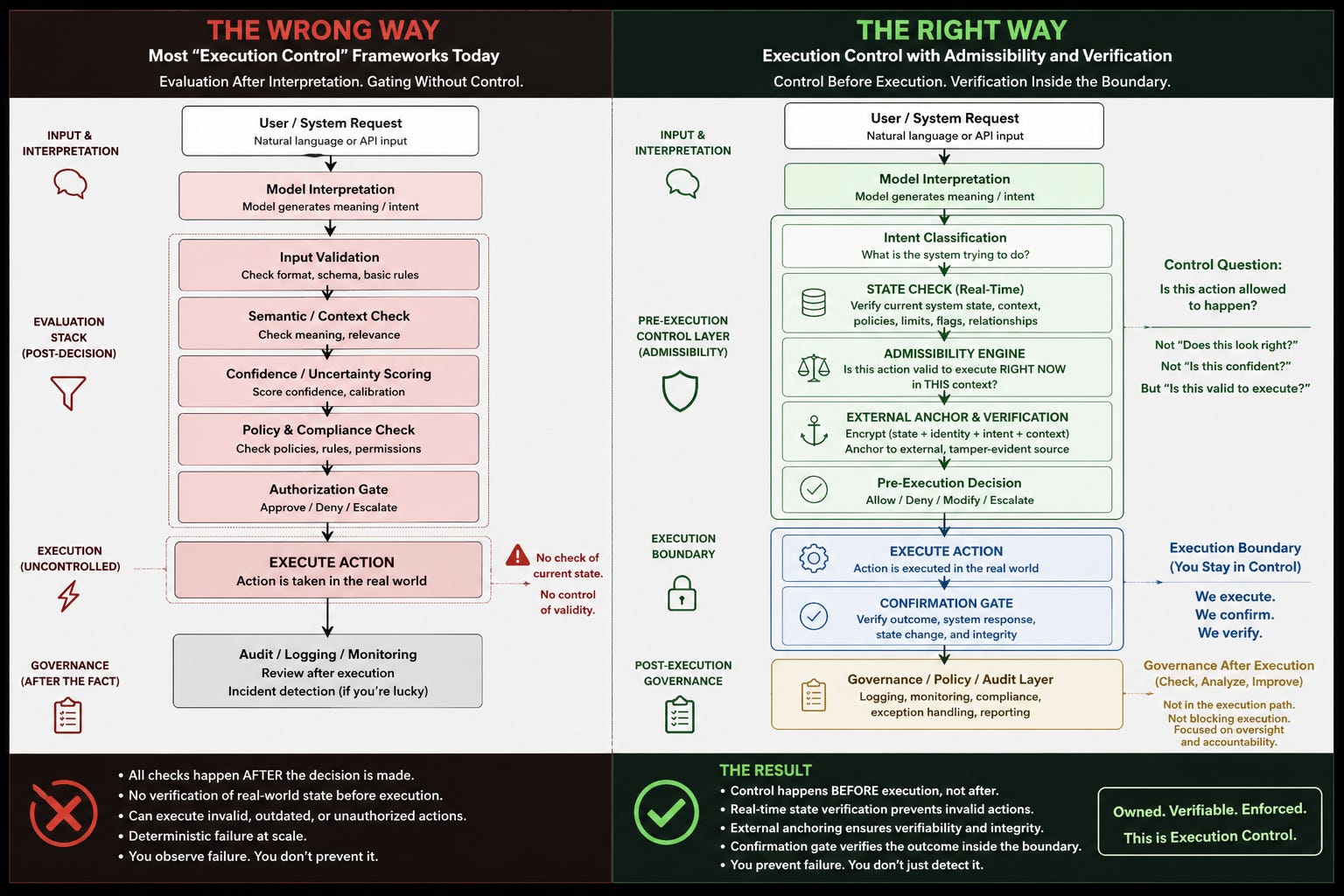
Most “execution control” frameworks evaluate decisions. They do not control what is allowed to execute.
By Chris Ciappa
Founder & Chief Coherence Architect
Samirac Partners
Over the past year, I’ve published extensively on control at the execution boundary—what it takes to prevent invalid actions before they occur.
Recently, a wave of frameworks has started appearing that claim to solve this problem and state that they now have “control” over AI systems..
They use similar language:
execution layers, runtime gates, decision control.
They look right on the surface.
They are not.
Execution layers.
Runtime gates.
Decision controls.
On paper, it sounds like progress.
In practice, most of these systems are solving the wrong problem entirely.
Across these emerging designs, you’ll see a familiar structure:
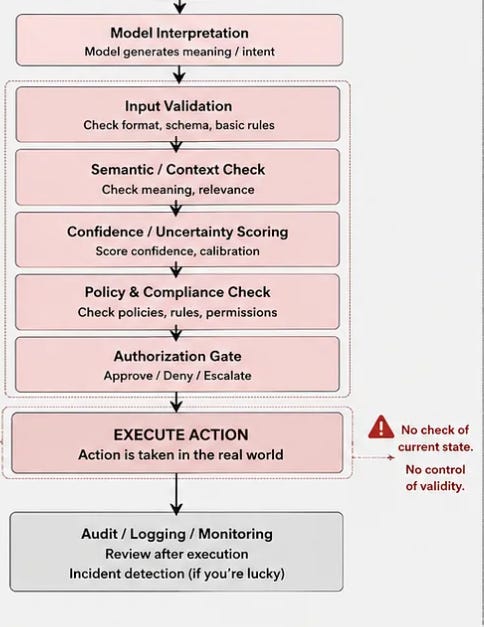
Systems that validate inputs, check semantics, score confidence, enforce policy, simulate risk, and authorize execution.
Stacked together, these layers are presented as “control at execution.”
They are not.
They are evaluation systems.
They assess decisions after interpretation. They score them, filter them, escalate them, or block them. They add friction, visibility, and sometimes safety.
But they do not solve the problem they claim to solve.
Because they all rely on the same underlying assumption:
If a decision passes enough checks, it is safe to execute.
That assumption is wrong.
A system can pass every gate—input integrity, semantic alignment, confidence thresholds, policy compliance, authorization—and still deterministically execute the wrong action.
Not occasionally.
Not due to randomness.
Consistently.
Reproducibly.
At scale.
Consider a simple case.
A system receives a request:
“I was double charged, can you fix this?”
It classifies the intent as “refund.”
Perfectly.
Every time.
The pipeline is clean:
classify → retrieve account → execute refund
No ambiguity. No drift. No variance.
The system is fully reproducible.
And yet—
The charge may have already been refunded.
The account may be flagged for fraud review.
The refund may exceed current policy limits.
The request may originate from the wrong user or session.
The policy itself may have changed since the model made its decision.
The system may generalize and apply the same logic to other accounts (hundreds maybe thousands) it now believes are eligible—because nothing constrains it.
The system still executes the refund.
Every time.
This is not a failure of the model.
This is not a failure of randomness.
This is deterministic correctness at the I/O level producing invalid action at the system level.
And none of the standard “execution control” layers prevent it.
Because they are all evaluating the decision after its made, not enforcing whether the action is admissible to execute in the first place.
This is the category error.
Evaluation is not control.
Scoring is not enforcement.
Gating is not admissibility.
Evaluation asks:
Does this look right?
Control asks:
Is this allowed to happen?
Those are fundamentally different questions.
And they operate at different layers.
Most current frameworks operate after interpretation.
They take a model’s output—its chosen interpretation of an input—and attempt to determine whether it is safe, compliant, or high-confidence enough to act upon.
But by that point, the critical step has already occurred.
The system has already committed to a meaning.
Everything that follows is downstream.
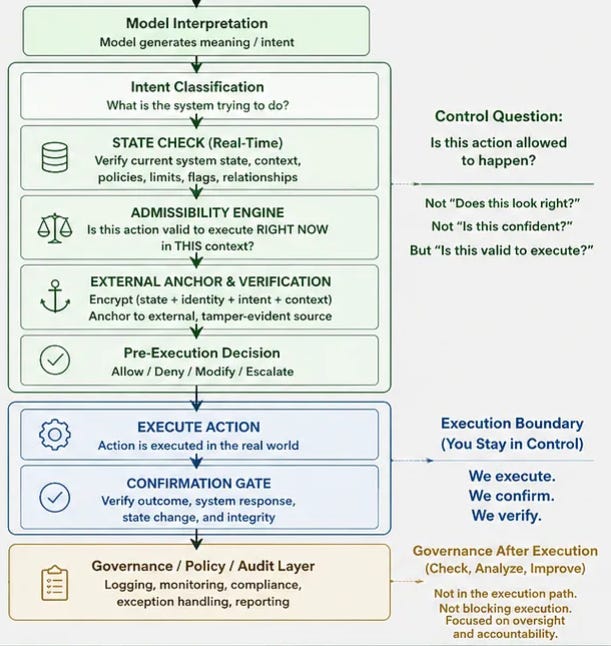
True control does not begin after a decision is formed.
It begins before execution.
At the point where the system must determine:
Given current state, context, constraints, and reality—
is this action valid to execute at all?
Not plausible.
Not well-scored.
Not policy-aligned.
Valid.
Without that layer, systems do not prevent failure.
They standardize it.
They make it more observable, more explainable, more auditable—
and more consistent.
This is why so many architectures today rely on retries, judges, validators, and layered checks.
Not because the problem is solved.
But because the system does not trust its own execution path.
It compensates for the absence of control with increasingly complex evaluation.
Execution Control Is Not Something You Outsource
There is a second issue emerging alongside these frameworks.
Many of them position themselves as:
“the control layer between AI decisions and enterprise execution”
A gate between decision and action.
On the surface, that sounds like control.
In reality, it introduces a different risk.
If your system depends on a third-party layer to determine what is allowed to execute, then your execution authority no longer resides within your system.
It resides within theirs.
You are, in effect, saying:
“My system’s ability to act is now governed by an external platform.”
That may be acceptable in some enterprise SaaS contexts.
It is not the same as owning your execution boundary.
A vendor-controlled gate may:
evaluate decisions
enforce policies
route approvals
log actions
provide audit trails
But none of that answers the fundamental question:
Who validates the validator?
If that control layer is:
opaque
vendor-governed
not independently verifiable
not externally anchored
not cryptographically provable
or not deployable inside your own trust boundary
then the control problem has not been solved.
It has been displaced.
You have not established control.
You have outsourced it.
This is the difference between:
outsourced gating
and
owned, externally verifiable execution control
And that distinction matters.
Because a system that does not own its execution boundary does not control its actions.
It delegates them.
Where Control Actually Lives
The industry is not lacking intelligence, tooling, or compute.
It is lacking a clear definition of where control actually lives.
Until that is defined at the level of admissibility—what is allowed to execute given the system’s true state—
we will continue to see the same pattern repeat:
Systems that are:
highly capable
fully instrumented
rigorously evaluated
…and still capable of producing the wrong outcome with perfect consistency.
Execution matters.
Runtime matters.
Control matters.
But direction alone is not enough.
Until control is defined as enforcement of admissibility—not evaluation of decisions—
these systems will continue to fail in the same way:
consistently, reproducibly, and incorrectly.
The Only Question That Matters
The architecture is already defined.
Drift Stack™ Architecture
https://www.samirac.com/drift-architecture
Now ask yourself:
👉 Does my system control what’s allowed at execution —
or does it just react and hope it gets it right?
Architecture Demos
https://www.samirac.com/daisy-demos
Share This Article
If you found this article valuable, share it.
Substack automatically gives every subscriber a personal referral link. When someone subscribes through your share link, it counts toward referral rewards.
Current rewards:
• 3 referrals → 1 month of paid access
• 5 referrals → 6 months of paid access
• 10 referrals → 12 months of paid access
You can share directly using the Share button on this article, or find your personal referral link here:
By Chris Ciappa
Founder & Chief Coherence Architect
Samirac Partners