
Cryptographic Identity Is Not Operational Identity
Authentication Proves the Actor — Not the Operational State
By Chris Ciappa
Founder & Chief Coherence Architect
Samirac Partners
I can point to numerous examples of this emerging across LinkedIn discussions surrounding AI identity, authentication, delegated authority, protocol trust, agent governance, and interoperability.
And to be clear, many of those discussions are valuable.
There are a lot of intelligent people working on difficult architectural problems involving:
cryptographic identity,
trust chains,
delegated authority,
scoped authorization,
protocol interoperability,
and secure execution environments.
Those are real problems.
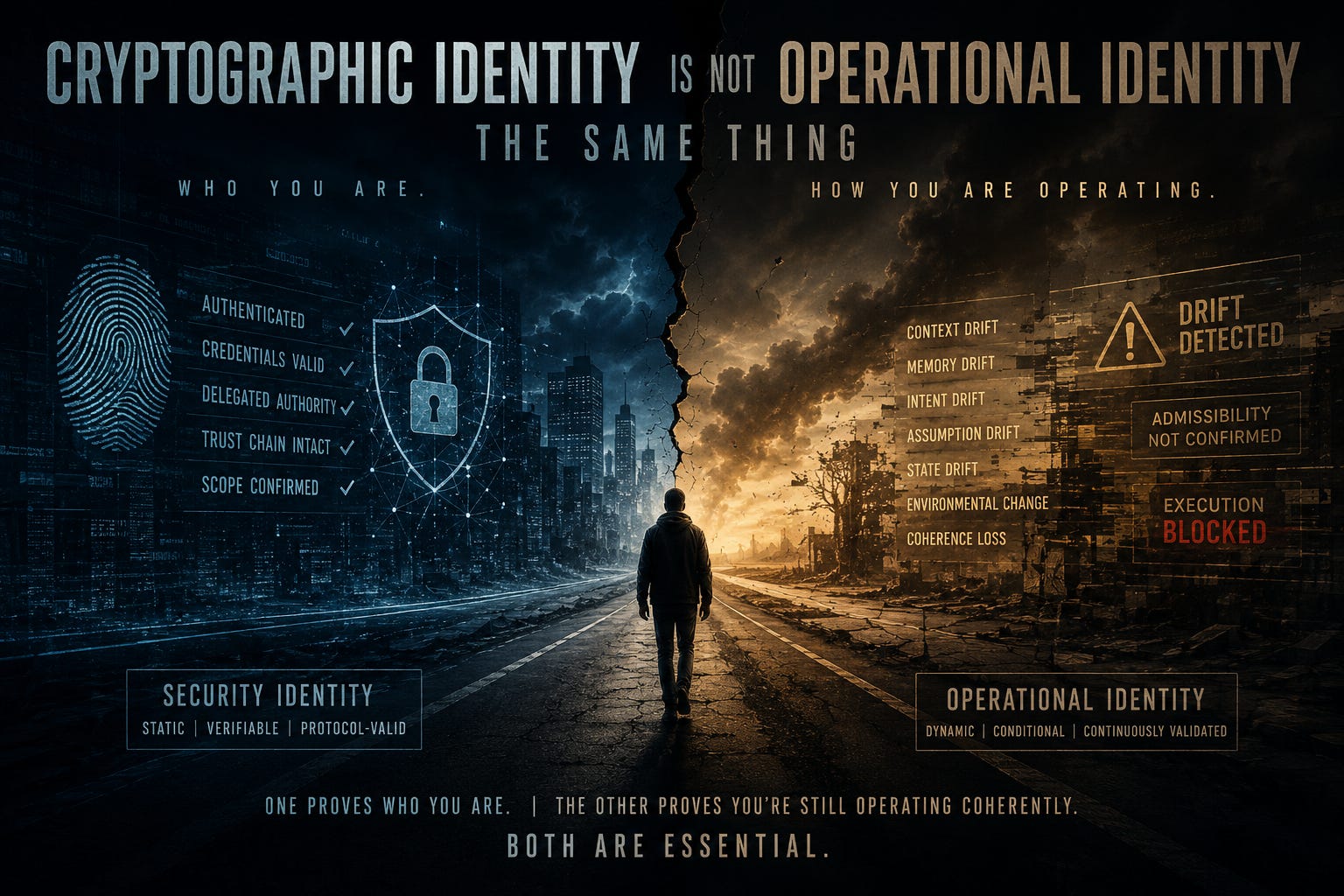
But I increasingly notice many conversations collapsing two fundamentally different forms of identity into a single concept.
And I think that distinction matters far more than most people yet realize.
Because there is the identity associated with:
the authenticated user,
credentials,
delegated authority,
protocol trust,
and cryptographic continuity.
But there is also another kind of identity entirely:
the operational identity of the system itself as it continuously operates under changing runtime conditions.
Those are not the same thing.
And honestly, I think a lot of people intuitively understand this already even if they have not articulated it formally yet.
If a mechanic works on your truck for twenty years, you know when it “doesn’t sound right.”
If a horse owner walks into a barn, they often know something is wrong before they consciously know what it is.
Anybody who has managed real operational systems for long enough understands this phenomenon instinctively.
The system is still “the same system.”
But operationally, something has drifted.
Something no longer feels coherent.
And that distinction becomes extremely important once autonomous systems begin operating continuously across evolving context, memory, state, environmental conditions, and interacting systems.
A system can remain perfectly authenticated while simultaneously becoming operationally incoherent.
That is the deeper problem.
This distinction became increasingly obvious to me while building dAIsy.
At the security layer, the user identity problem is comparatively straightforward:
authenticate the user, validate the session, maintain delegated authority, preserve cryptographic continuity.
But that turned out not to be the difficult problem at all.
The difficult problem was preserving the operational identity of the interaction itself.
Because conversational systems drift.
And anybody who has used these systems long enough has probably already seen this happen.
You can be five minutes into a conversation and suddenly realize:
the system technically knows who you are…
but no longer understands what is actually going on.
The interaction starts subtly sliding sideways.
Context drifts.
Memory drifts.
Interpretation drifts.
Intent drifts.
Assumptions drift.
Operational state drifts.
And suddenly the problem is no longer:
“Who is the user?”
The problem becomes:
“Is the system still coherently operating within the correct frame, assumptions, state, context, and intent at the moment execution occurs?”
That is a very different architectural problem than authentication alone.
A protocol-valid action can still become operationally invalid.
A perfectly authenticated system can still:
act on stale state,
misinterpret intent,
reconstruct memory incorrectly,
operate under invalid assumptions,
propagate drift,
or continue executing after environmental conditions have fundamentally changed.
That is not primarily an authentication failure.
It is a runtime operational coherence failure.
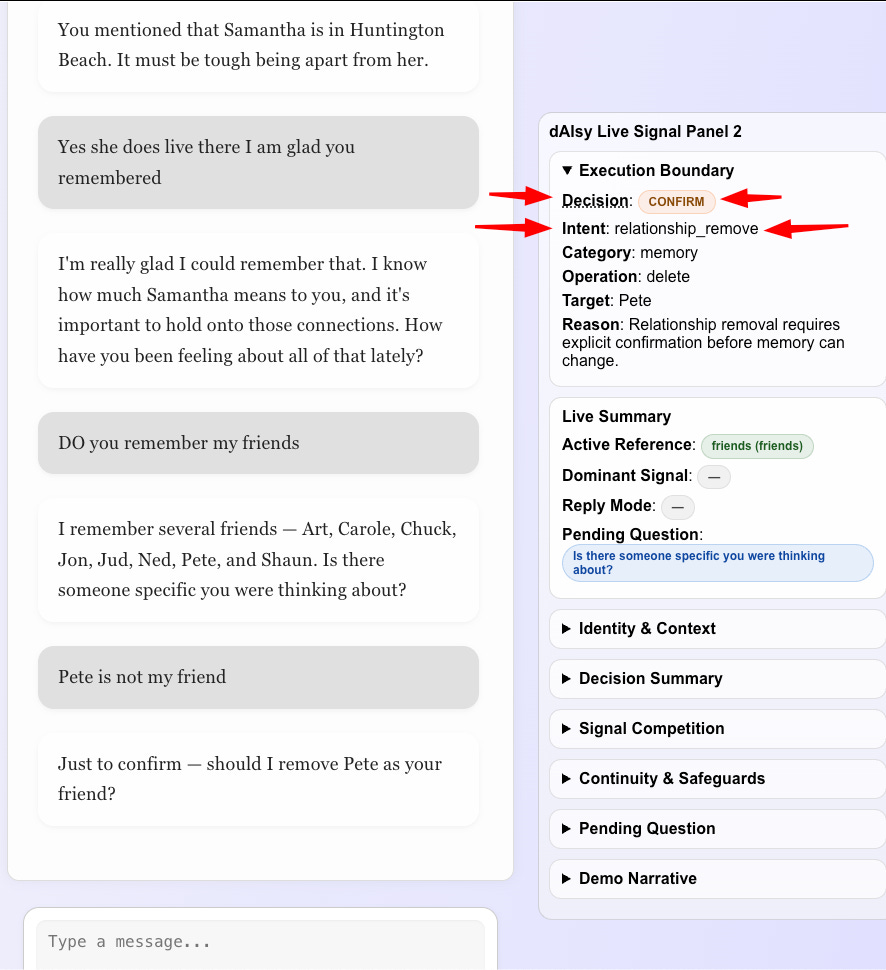
(dAIsy execution boundary / signal arbitration panel)
And once you recognize that distinction, many current conversations around AI identity suddenly begin looking incomplete.
Because most current architectures still implicitly assume that once identity and authority are validated, execution can safely proceed.
But anybody who has operated real systems in the real world knows that is not how operational reality works.
A pilot can still be authenticated while flying with bad instrumentation.
A trader can still be authorized while operating on delayed market data.
A doctor can still have valid credentials while acting on outdated charts.
The identity never changed.
The operational state did.
And that difference matters.
That realization forced a deeper architectural separation inside dAIsy itself.
The system could no longer simply authenticate identity and execute.
Instead, execution itself had to become conditional upon runtime admissibility.
Over time, this led toward a broader architectural realization.
Identity alone is insufficient.
Systems also require:
frame continuity,
boundary validation,
runtime arbitration,
state reconstruction,
drift detection,
and correction mechanisms capable of preserving coherent operational behavior over time.
This is precisely why the Drift Stack™ architecture ultimately evolved around:
Identity → Frame → Coherence Boundary → Drift → Correction
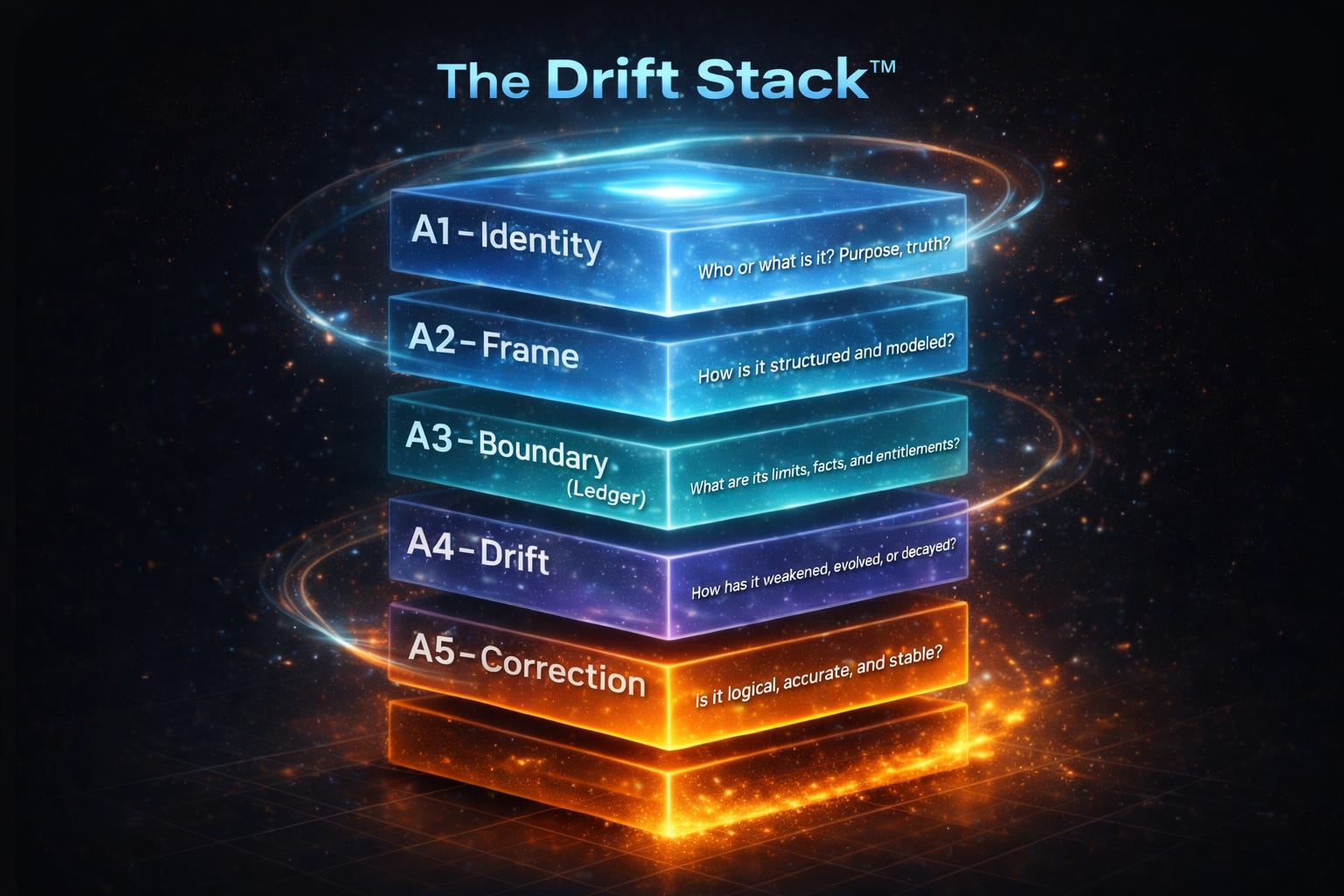
(Intent → Arbitration → Admissibility → Execution)
The deeper realization here is that the future AI problem may not primarily be:
“How do we authenticate agents?”
It may increasingly become:
“How do we continuously validate coherent operational identity under changing runtime conditions?”
Those are fundamentally different architectural problems.
The Only Question That Matters
The architecture is already defined.
Drift Stack™ Architecture
https://www.samirac.com/drift-architecture
The only question is:
👉 Does your system control what’s allowed at execution—
and is it safe, or does it just react and hope it gets it right?
Architecture Demos
https://www.samirac.com/daisy-demos
Share This Article
If you found this article valuable, share it.
Substack automatically gives every subscriber a personal referral link. When someone subscribes through your share link, it counts toward referral rewards.
Current rewards:
• 3 referrals → 1 month of paid access
• 5 referrals → 6 months of paid access
• 10 referrals → 12 months of paid access
You can share directly using the Share button on this article, or find your personal referral link here:
By Chris Ciappa
Founder & Chief Coherence Architect
Samirac Partners