
AI Trust Theater
When the Language of Safety Replaces the Architecture of Safety
By Chris Ciappa
Founder & Chief Coherence Architect
Samirac Partners
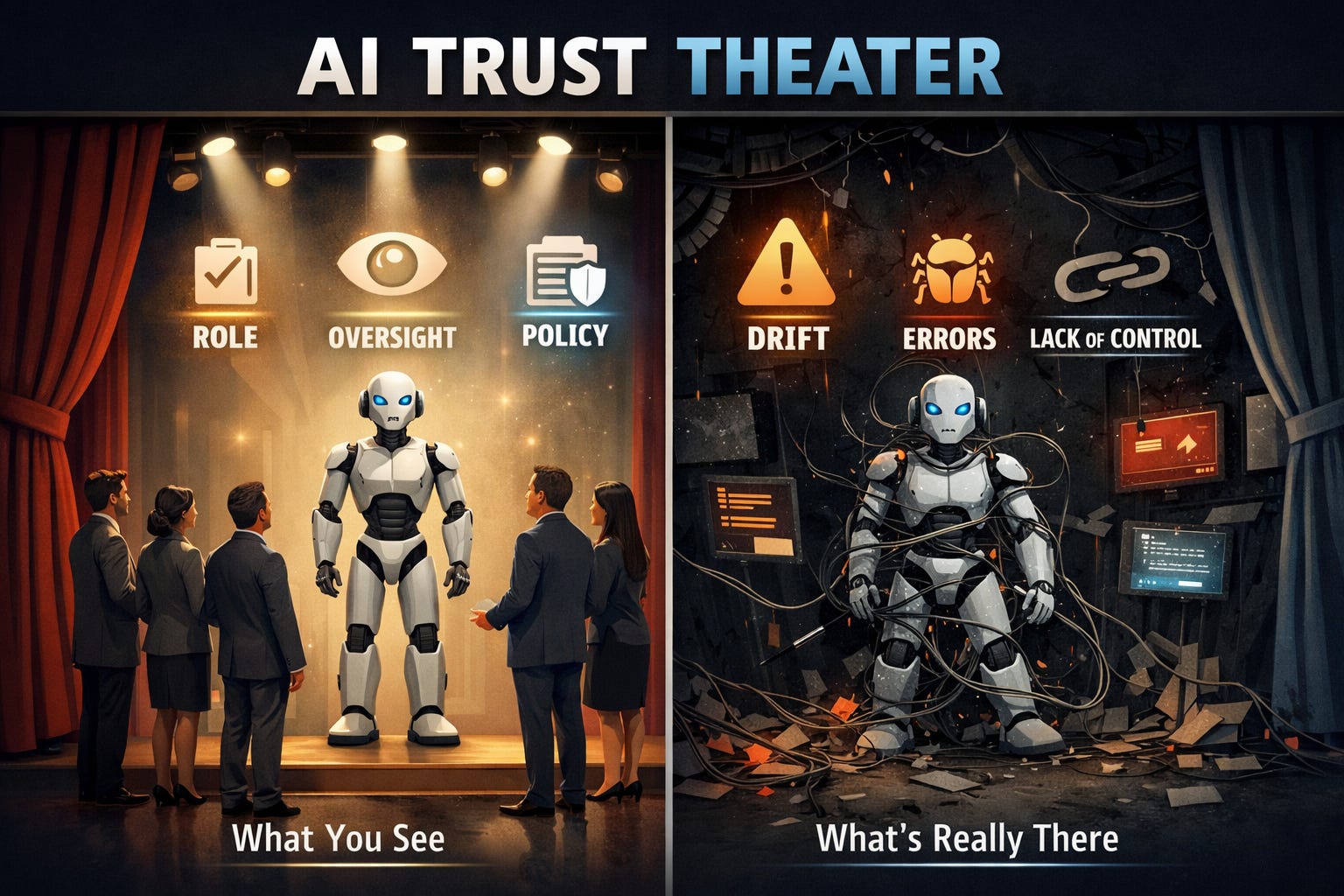
Modern AI systems often signal trust through roles, dashboards, and reassuring language.
But real trust in complex systems comes from structure that constrains execution.
When the Language of Safety Replaces the Architecture of Safety
I recently watched a 20-minute product presentation introducing something called AI specialists.
The idea is simple.
You take a job description.
Five minutes later that job description becomes an AI teammate.
It resets passwords.
Unlocks accounts.
Handles service desk tickets.
Resolves routine incidents.
Managers get dashboards.
Performance metrics.
Visibility into what the agent is doing.
And the executives keep repeating reassuring phrases:
“Autonomous teammates.”
“Defined roles.”
“Manager visibility.”
“Full control.”
The message is clear:
This isn’t just automation.
This is a digital employee.
And honestly, the operational capability is impressive.
But as I watched the presentation, something started to stand out.
They kept talking about trust.
But they never showed the structure that actually creates it.
Words That Sound Like Safety
Listen carefully to the language.
The AI specialists:
• have defined roles
• learn from human interaction
• inherit 20 years of enterprise knowledge
• give managers full visibility and control
Those phrases are doing a lot of work.
They hint at boundaries.
They hint at governance.
They hint at safety.
But they never actually show how those things are enforced.
It’s words suggesting structure.
Not structure itself.
Visibility Is Not Control
One thing the demo emphasized repeatedly was the manager dashboard.
Managers can see:
• how many incidents the AI handled
• how fast they were resolved
• performance alongside the human team
That’s useful.
But dashboards don’t actually control anything.
They only show you what already happened.
That’s like watching a replay of a football game and saying you controlled the play.
You didn’t.
You just watched it afterward.
Visibility can tell you what the system did.
Control determines what the system is allowed to do in the first place.
Seeing what an AI did is helpful.
Stopping a bad action before it executes is something entirely different.
“Learns From Every Human Interaction”
Another phrase that kept coming up:
“The AI learns from every human interaction.”
That sounds great at first.
But think about it for a second.
Learn what?
From whom?
Under what rules?
Because anyone who has worked inside a large enterprise knows something important:
People don’t always follow the policy.
They follow the shortcut.
They follow what worked last time.
They follow whatever closes the ticket fastest.
Over time those shortcuts accumulate.
The organization slowly drifts away from the original design.
If an AI system simply learns from human behavior, it may not correct that drift.
It may just learn the drift faster.
Unlimited Capacity
Another part of the demo sounded impressive.
These AI specialists can work tickets in parallel.
They don’t process one request at a time like humans.
They can handle thousands simultaneously.
That’s powerful.
But it also changes the risk profile.
When a human makes a mistake, the damage spreads slowly.
When a machine makes a mistake, the damage spreads at machine speed.
Parallel capacity scales productivity.
But it also scales error propagation.
A Role Is Not a Boundary
The presentation repeatedly emphasized that the AI has a defined role.
For example:
Level-1 service desk specialist.
That sounds reassuring because it mirrors how we structure human teams.
But a role description is not the same thing as an authority boundary.
A job title tells you what someone usually does.
It doesn’t define:
• what actions are forbidden
• what policies override others
• when escalation must occur
• what conditions stop execution
Without those structural constraints, a role describes behavior.
It doesn’t necessarily limit it.
