
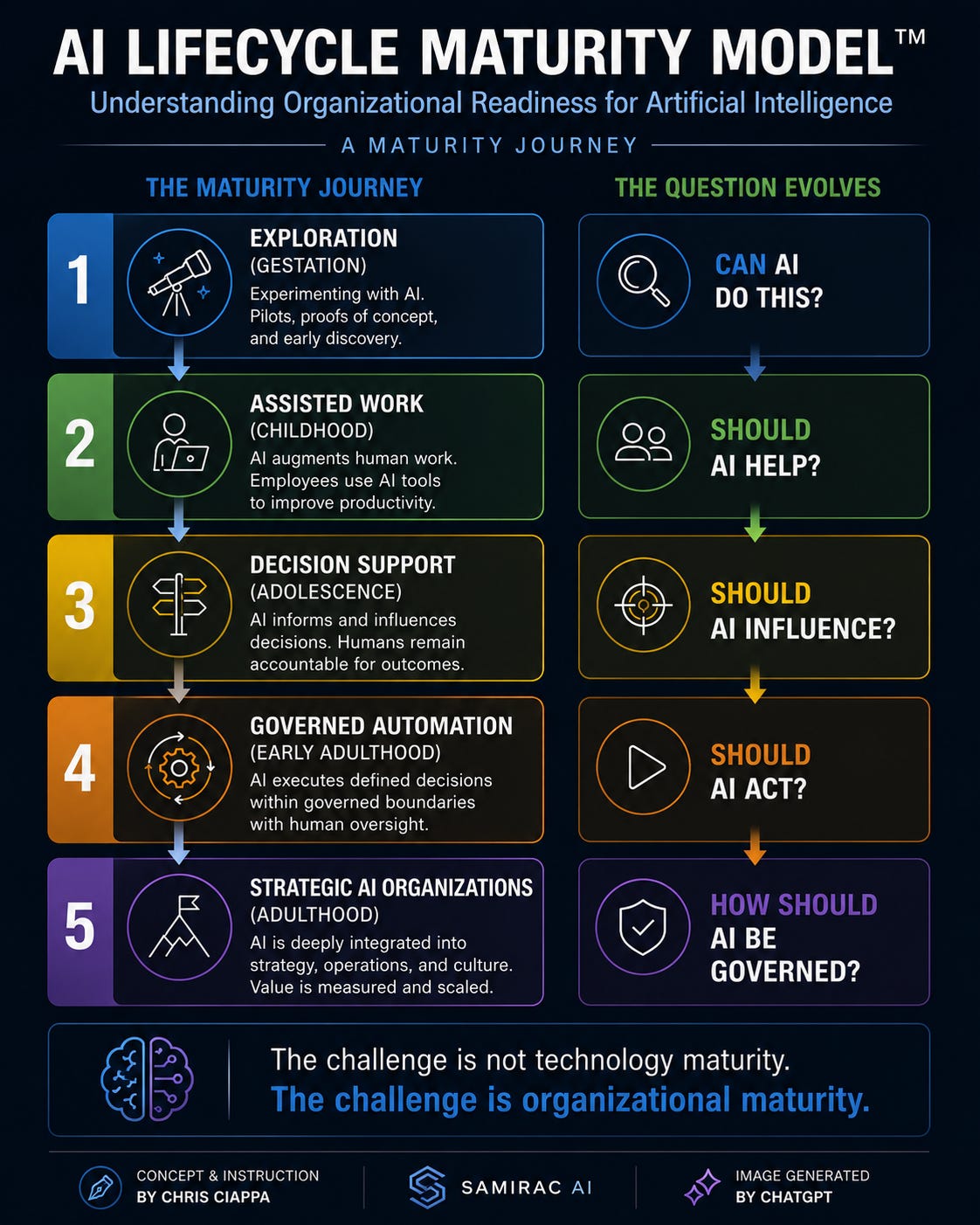
AI Lifecycle Maturity Model™
Understanding Organizational Readiness for Artificial Intelligence
Chris Ciappa
Founder & Chief Architect
Samirac AI
Introduction
Artificial Intelligence has become a strategic concern for nearly every organization.
Executives are being told they need an AI strategy. Employees are experimenting with new tools. Vendors are promising productivity gains, competitive advantages, automation, and transformation. Everywhere you look, someone is explaining why artificial intelligence will change everything.
Perhaps it will.
The more immediate challenge is figuring out what any of that actually means inside a real organization.
After several decades in technology, I’ve watched the same pattern repeat itself through data warehousing, business intelligence, big data, cloud computing, digital transformation, and now artificial intelligence. The names change. The vendors change. The marketing changes. Yet the first mistake organizations make remains remarkably consistent.
They start with technology.
Someone sees a demonstration. Someone attends a conference. Someone reads an article about a competitor’s success. Before long the conversation turns to models, platforms, vendors, architectures, integrations, budgets, and implementation plans.
Everybody becomes focused on how.
Very few people stop to ask whether they have identified the right what.
Organizations do not realize value from technology itself. They realize value from applying technology to meaningful business problems. The challenge is not deploying artificial intelligence everywhere it can be deployed. The challenge is determining where it belongs, where it creates value, where it introduces risk, and where it should never be deployed at all.
That distinction is more important than it may first appear.
Most organizations can identify dozens, sometimes hundreds, of potential AI opportunities. Some will deliver substantial value with manageable risk. Others will consume time, money, and attention while producing very little benefit. A few may introduce governance, operational, regulatory, or execution risks that far outweigh any potential advantage.
The first challenge, therefore, is not implementation.
It is selection.
Before an organization decides how artificial intelligence should be deployed, it must first determine where it should be deployed. Before selecting a model, it should understand the problem. Before selecting a vendor, it should understand the outcome.
That requires a different way of thinking.
It requires understanding not only the opportunities artificial intelligence creates, but also the maturity required to support those opportunities successfully.
This paper explores that challenge through the lens of organizational maturity. Rather than viewing artificial intelligence primarily as a technology problem, it examines how organizations evolve from initial curiosity and experimentation toward responsible adoption, governance, automation, and strategic integration.
Because the most important question is rarely whether artificial intelligence can do something.
The more important question is whether the organization is ready for it.
The Nature of Artificial Intelligence
Every major technology wave arrives with a mixture of excitement, confusion, optimism, fear, and exaggerated claims.
Artificial intelligence is no exception.
Depending on who is speaking, AI is either about to transform every industry on earth, eliminate millions of jobs, create unprecedented economic growth, destroy civilization, or somehow accomplish all four simultaneously. The volume of discussion surrounding artificial intelligence has become so loud that many organizations struggle to separate what the technology actually is from what people imagine it might become.
That confusion is understandable.
Most organizations encounter artificial intelligence through demonstrations rather than direct experience. Someone attends a conference, watches a product presentation, reads an article, or sees a competitor announce a new initiative. A few impressive examples are shown, expectations begin forming, and before long executives are discussing strategy while employees are experimenting with tools.
What often gets lost in the excitement is a more fundamental question.
What exactly makes artificial intelligence different from the technologies that came before it?
The answer is important because many organizations approach AI using assumptions developed during decades of traditional software implementation. Those assumptions served them well in the past, but artificial intelligence introduces characteristics that make the challenge substantially different.
Traditional software is generally designed around explicit instructions. A developer defines rules, conditions, calculations, and outcomes. The system follows those instructions repeatedly and predictably. Given the same inputs, the same outputs are usually produced. Organizations have spent decades learning how to build, govern, secure, audit, and support systems that operate in this manner.
Artificial intelligence behaves differently.
Rather than relying exclusively on explicit programming, artificial intelligence frequently operates through inference. Instead of being told exactly how to respond in every situation, it evaluates information, identifies patterns, and generates outputs based upon what it has learned. The distinction may appear subtle, but its implications are significant.
A calculator follows instructions while a human being applies judgment. Artificial intelligence often operates somewhere between those two worlds, which is one reason organizations frequently struggle to determine how it should be governed.
The challenge becomes even more apparent when artificial intelligence moves beyond simple productivity tasks and begins participating in decision processes. Traditional software often supports decisions by storing information, generating reports, or enforcing predefined business rules. Artificial intelligence increasingly participates in the decision-making process itself by generating recommendations, prioritizing alternatives, identifying patterns, summarizing information, and influencing how people interpret situations.
That does not necessarily mean AI is making the decision.
It does mean AI may influence the person who does.
The difference is important.
Anyone who has raised children understands that influence and authority are not the same thing. A teenager may strongly influence a family discussion without possessing the authority to make the final decision. Yet that influence still matters because it affects the outcome.
Artificial intelligence frequently occupies a similar position inside organizations.
As adoption continues, AI is also moving closer to operational workflows where its outputs influence actions, communications, approvals, recommendations, and business outcomes. In many cases the technology is no longer operating at the edge of the organization. It is gradually becoming part of the organization’s operating fabric.
That transition changes the nature of the challenge.
Consequently we need not be asking whether artificial intelligence can generate useful outputs.
The real question is how those outputs should be evaluated, governed, constrained, trusted, monitored, and integrated into business processes that carry real consequences.
This is where many discussions about artificial intelligence begin to drift off course.
People naturally focus on capability because capability is visible. Demonstrations showcase capability. Marketing emphasizes capability. Product vendors compete on capability.
Organizations, however, do not realize value from capability alone. They realize value from the responsible application of capability, which is why capability and suitability are not the same thing.
They realize value from the responsible application of capability.
That distinction sits at the center of nearly every successful AI initiative.
The problem is not whether artificial intelligence can perform a task.
The problem is whether it should perform that task.
Capability ≠ Suitability
Influence ≠ Authority
Potential ≠ Value
Technology alone does not determine success.
The organization does.
The Fundamental Misunderstanding
One of the reasons artificial intelligence creates so much confusion in organizations is that people instinctively compare it to software they already understand.
At first glance, that seems perfectly reasonable. AI runs on computers, lives inside applications, integrates with existing systems, and is usually purchased from software vendors. To most executives, managers, and employees, it arrives through the same channels as every other technology initiative they’ve seen during their careers. It gets budgeted, evaluated, approved, implemented, and supported. From a distance, it looks like the next generation of enterprise software.
The trouble begins when people assume it behaves like enterprise software.
For most of the last fifty years, organizations have become accustomed to systems that behave in predictable ways. If an employee enters a customer number, the system retrieves the customer. If accounting runs a report, the calculations remain consistent. If payroll determines an employee should receive a paycheck, nobody expects a different answer tomorrow morning. Traditional software behaves more like a calculator than a colleague. Given the same inputs, it generally produces the same outputs, and because of that predictability organizations have developed an entire set of management practices around it. They know how to buy it, implement it, secure it, audit it, support it, and govern it.
Artificial intelligence arrives wearing the clothing of software while behaving much more like a person.
That distinction is easy to miss during a demonstration.
Imagine hiring a new employee. After reviewing their résumé, conducting interviews, checking references, and evaluating experience, you eventually conclude they seem intelligent, capable, and qualified. Most organizations would view that as the beginning of a relationship rather than the end of an evaluation. The employee still has to learn the business, understand the culture, gain experience, earn trust, and demonstrate judgment before significant authority is placed in their hands.
Nobody hires a new employee on Monday and gives them unrestricted control over payroll, purchasing, hiring, contracts, compliance, and corporate strategy by Friday.
At least nobody survives doing it for very long.
Artificial intelligence often enters organizations through a very different process. Someone attends a conference, watches a product demonstration, reads an article, or sees a competitor announce an initiative. A few impressive examples are shown, a few surprisingly intelligent answers are generated, and before long conversations begin about implementation. The technology appears capable, the demonstration appears convincing, and the organization gradually begins treating capability as evidence of readiness.
That is usually the first wrong turn.
Years ago, during the business intelligence boom, I occasionally encountered executives who believed dashboards would solve their decision-making problems. The assumption was understandable. If information is valuable, then more information should be even more valuable. Yet many organizations discovered something surprising after spending significant amounts of money building reporting systems.
The reports worked.
The databases worked.
The dashboards worked.
What often didn’t work was the organization itself.
Departments disagreed about definitions. Metrics meant different things to different groups. Incentives pulled people in conflicting directions. Managers could look at the same report and reach entirely different conclusions. The technology wasn’t creating those problems. It was exposing them.
Artificial intelligence is producing a remarkably similar effect.
Organizations frequently become fascinated by what the technology can do while spending far less time considering where it belongs. A language model might review contracts, summarize medical records, recommend job candidates, prioritize support tickets, analyze financial information, or assist with countless other activities. The list of possibilities seems almost endless, which is precisely why so many organizations become distracted by possibility before they establish suitability.
The technical discussion naturally focuses on capability. People want to know whether the model can perform the task, achieve acceptable accuracy, integrate into existing workflows, and operate at a reasonable cost. Those are legitimate questions, but they are rarely the most important ones.
The more important questions tend to arrive later.
Should the model be involved in this process at all?
What happens when it is wrong?
Who is accountable for the outcome?
How will decisions be reviewed, challenged, corrected, or reversed when circumstances change?
Unfortunately, by the time those questions appear, implementation has often already begun. The organization has invested money, time, political capital, and executive attention into the initiative, which makes objective evaluation increasingly difficult. Instead of asking whether the deployment makes sense, people begin searching for reasons to justify continuing it.
Most AI failures do not occur because the technology was incapable. Many occur because the technology performed exactly as expected while the surrounding organization lacked the maturity necessary to support it. Governance was incomplete, oversight was weak, accountability was unclear, and monitoring or escalation procedures either did not exist or were never seriously considered. Everyone was focused on what the technology could do, while very few people were focused on what should happen when things inevitably went wrong.
That is why artificial intelligence should not be viewed primarily as a technology challenge. It is an organizational maturity challenge. The technology may be ready long before the organization is prepared to absorb it, and understanding that distinction is the first step toward responsible adoption.
Capability ≠ Readiness
Demonstration ≠ Deployment
Intelligence ≠ Authority
Maturity must come before autonomy.
Selection Before Implementation
After a few decades in technology, the individual trends begin to blur together. The names change, the vendors change, the marketing changes, and every new wave arrives convinced that it is fundamentally different from everything that came before it. Yet the organizational behavior surrounding adoption remains remarkably consistent.
I watched it happen with data warehousing. Then business intelligence. Then big data. Then cloud computing. Then digital transformation. Now artificial intelligence has taken its turn, and once again organizations find themselves trying to separate genuine opportunity from hype, urgency from importance, and possibility from practicality.
The cycle usually begins the same way.
Someone attends a conference, reads an article, watches a demonstration, or hears that a competitor is investing heavily in the latest technology. A few impressive examples are shown, a few success stories are repeated, and before long conversations begin about implementation. Budgets are discussed. Committees are formed. Vendors are evaluated. Roadmaps appear. Everybody becomes busy.
What is interesting is how often those conversations begin before anyone has clearly defined the problem they are trying to solve.
Years ago, while helping organizations build data warehouses and business intelligence systems, I learned a lesson that has stayed with me ever since. Most organizations did not suffer from a shortage of technology. In fact, many had more technology than they knew what to do with. What they lacked was clarity.
They knew they wanted better decisions, better visibility, and they certainly wanted faster answers. What they could rarely agree upon was which questions actually mattered, which problems deserved attention first, and what success would look like if they achieved it.
Artificial intelligence is exposing that same weakness all over again.
Ask ten managers where AI should be deployed and you may receive fifteen answers. Customer service wants chatbots. Marketing wants content generation. Finance wants forecasting. Operations wants automation. Human Resources wants screening and summarization. Legal wants document review. IT wants agents. Every department can produce a list of opportunities almost immediately, and many of those opportunities sound perfectly reasonable when viewed in isolation.
The challenge is not finding opportunities.
The challenge is deciding which opportunities deserve attention, which should wait, and which should never leave the whiteboard in the first place.
That distinction sounds subtle until real money becomes involved.
A company can spend six months implementing a sophisticated capability only to discover that it solved a problem nobody truly cared about. I’ve watched organizations spend enormous amounts of time and money optimizing processes that were merely inconvenient while completely ignoring processes that were constraining the business every single day. The technology performed exactly as expected. The value simply wasn’t there.
Technology has a habit of doing that. It encourages people to become fascinated with solutions before they fully understand the problem.
One of my favorite examples comes from outside technology altogether.
A friend of mine once bought a beautiful fishing boat. It had multiple displays, navigation systems, sonar, radar, and enough electronics to convince you he was preparing for an expedition around the world. It was genuinely impressive. The only problem was that he rarely went fishing.
He spent far more time talking about the boat than using the boat.
Over time the equipment became the objective. The original purpose quietly disappeared into the background.
Organizations sometimes do exactly the same thing. What begins as an effort to solve a business problem slowly transforms into a discussion about models, architectures, vendors, agents, frameworks, integrations, and deployment plans. Before long, people are spending more time discussing the mechanics of the solution than the problem that justified the initiative in the first place. The model becomes the topic of conversation. The architecture becomes the center of attention. Meanwhile, the original business objective quietly drifts into the background.
Without realizing it, the organization begins measuring progress by implementation activity rather than business outcomes. Teams become occupied with deployment plans, vendor evaluations, architecture diagrams, integrations, and proofs of concept while the original reason for pursuing the initiative becomes increasingly difficult to articulate.
That is why the first challenge facing an organization is not implementation.
It is selection.
Before selecting a model, select a problem.
Before selecting a vendor, select an outcome.
Before selecting an architecture, determine whether the opportunity is worth pursuing in the first place.
Those questions are not as exciting as implementation discussions, but they are the questions that ultimately determine success.
Desired Outcomes ≠ Implementation Understanding
Capability ≠ Value
Implementation ≠ Adoption
Activity ≠ Progress
The organizations that succeed with artificial intelligence eventually learn a simple lesson. Technology should follow clarity, not the other way around. Implementation comes later.
Maturity comes first.
The AI Lifecycle
Imagine walking into two different organizations and asking a simple question.
“How far along are you with AI?”
The first organization proudly explains that artificial intelligence is everywhere. Employees use ChatGPT every day. Marketing generates content with it. Human Resources summarizes résumés. Managers draft presentations and reports with it. Somebody in IT has built an internal chatbot, and several departments are experimenting with agents. The executive team is enthusiastic because adoption appears widespread and employees seem engaged.
The second organization responds very differently.
They describe only a handful of deployments. Usage is monitored. Outcomes are measured. Governance requirements have been documented. Some opportunities have been approved, others have been rejected, and several remain under evaluation because the organization has not yet determined whether the potential value justifies the associated risk.
Which organization is more mature?
Most people answer too quickly.
The first organization appears farther along because more people are using AI. The second appears slower because adoption has been more deliberate and controlled.
The answer, however, depends entirely upon what we mean by maturity.
For most of human history we have understood that growth and maturity are not the same thing. A child can grow taller without becoming wiser. A teenager can become more confident without becoming more responsible. An adult can acquire authority without necessarily developing judgment. Every parent understands this intuitively because they have watched it happen firsthand.
Organizations behave much the same way.
Artificial intelligence is often described as a technology journey, but in practice it behaves far more like a maturity journey. Organizations begin with curiosity. They experiment. They become excited. They make mistakes. They occasionally become overconfident. Eventually they learn which assumptions were correct, which expectations were unrealistic, and which lessons only experience can teach.
The technology may advance rapidly, but organizational maturity develops much more slowly.
That distinction matters because many AI failures are not technology failures at all. The model works. The integration works. The infrastructure works. In many cases the deployment performs exactly as designed. What fails is the organization’s ability to govern, supervise, evaluate, constrain, or absorb the capability it has introduced.
Years ago, during the business intelligence era, I watched a remarkably similar pattern unfold. Organizations frequently assumed that purchasing a reporting platform would somehow make them data driven. Dashboards were built, reports were distributed, and executives expected better decisions to follow naturally.
They rarely did.
Better decisions do not emerge from software alone. They emerge from people, communication, accountability, incentives, governance, and judgment. The reports simply exposed strengths and weaknesses that already existed inside the organization. Teams with strong leadership often benefited tremendously. Teams with poor communication, conflicting incentives, or unclear ownership frequently discovered that technology amplified existing dysfunction rather than eliminating it.
Artificial intelligence appears to be following the same path.
The technology is impressive. In many cases it is genuinely transformative. Yet transformation rarely occurs because a tool exists. Transformation occurs because an organization develops the maturity necessary to use that tool effectively.
That is why the AI Lifecycle Maturity Model is not really a model of technology adoption.
It is a model of organizational development.
Every parent eventually learns that maturity cannot be rushed. A five-year-old may desperately want the privileges of a teenager, and a teenager may desperately want the freedoms of an adult, but development occurs in stages for a reason. Capability arrives gradually. Judgment arrives more slowly. Responsibility follows only when both have had time to mature.
Organizations adopting artificial intelligence frequently discover the same reality.
The first successful pilot creates confidence. The second creates enthusiasm. The third creates expectations. Before long, leaders begin assuming the organization is more mature than it actually is. The temptation to skip stages becomes powerful because the benefits appear so obvious and the opportunities seem so abundant.
Unfortunately, maturity does not care about enthusiasm.
It develops at its own pace.
Real organizations do not move neatly from one stage to another. Progress is uneven. Different departments often exist at different stages simultaneously. A company may demonstrate remarkable maturity in one area while behaving like a complete beginner in another. Human beings develop in much the same way. A child may display remarkable maturity one day and astonishing immaturity the next. Teenagers frequently oscillate between insight and recklessness with breathtaking speed. Adults are not immune either. Experience improves judgment, but it does not eliminate mistakes.
Organizations follow a remarkably similar pattern. They learn, adapt, regress, recover, and occasionally repeat the same mistakes they swore they would never make again. Anyone who has spent enough time around large organizations eventually realizes that maturity is not a destination waiting at the end of a roadmap. It is an ongoing process of learning, correction, adaptation, and growth.
Understanding that process provides leaders with something incredibly valuable: context. It allows them to evaluate their current situation more honestly, recognize the challenges that typically accompany each stage of development, and avoid confusing activity with progress. It also helps explain why the objective is not maximum AI adoption. The objective is appropriate AI adoption. Some opportunities deserve immediate attention, others require additional maturity before deployment, and a surprising number should remain on the drawing board until the organization is prepared to support them.
The lifecycle that follows describes the path most organizations travel as they move from initial curiosity and experimentation toward strategic integration of artificial intelligence. Like the stages of human development, each phase introduces new opportunities, new responsibilities, new risks, and new lessons. Some organizations progress steadily. Others stall. A few attempt to skip stages entirely and discover that technology can move much faster than organizational maturity.
Maturity usually wins that race in the end.
Growth ≠ Maturity
Adoption ≠ Readiness
Activity ≠ Progress
Capability ≠ Judgment
Technology evolves rapidly.
Maturity develops deliberately.
Exploration – (Gestation)
Before a child is born, a curious thing happens.
Everybody starts making plans.
Parents discuss names. Bedrooms are prepared. Expectations form. Family members imagine personalities that do not yet exist. Advice arrives from every direction, some of it useful and some of it wildly contradictory. Excitement grows faster than understanding because everyone is thinking about potential rather than reality.
At this stage, almost everything is expectation.
Very little is experience.
Organizations frequently enter artificial intelligence in much the same way.
Long before the first production deployment occurs, executives begin hearing success stories. Employees experiment with new tools. Vendors make increasingly ambitious promises. Articles appear describing extraordinary productivity gains, competitive advantages, and transformational outcomes. Every conversation seems to suggest that the future is arriving faster than expected and that everyone else is already ahead.
The result is predictable.
Expectations begin forming long before operational understanding exists.
That is not necessarily a problem.
In fact, it is often a healthy part of the process.
Exploration is where organizations learn the language of artificial intelligence. Teams begin separating reality from marketing. Leaders discover which problems AI may help solve and which problems remain stubbornly resistant. Employees gain familiarity with capabilities, limitations, strengths, weaknesses, and failure modes. Curiosity is encouraged because curiosity is often the precursor to innovation.
The danger lies in confusing exploration with maturity.
A family that has prepared a nursery has not yet raised a child.
An organization that has experimented with ChatGPT has not yet adopted artificial intelligence.
Those are very different things.
Most organizations spend longer in this stage than they realize.
Part of the reason is that exploration feels productive. New tools are being tested. Demonstrations are taking place. Pilot projects are being discussed. Meetings are scheduled. Articles are shared. Employees exchange prompts and compare results. From the outside, the organization appears to be moving quickly.
Sometimes it is.
Sometimes it is simply circling.
Years ago, during the business intelligence boom, I watched organizations spend months debating reporting platforms before anyone had agreed upon the metrics they actually wanted to measure. The technology conversation was easy because software could be purchased. The business conversation was difficult because it required agreement.
Artificial intelligence often exposes the same tendency.
Organizations frequently become fascinated by models, agents, architectures, and vendors long before they have developed a clear understanding of where value might actually be created. Discussions drift toward implementation because implementation feels tangible. Questions about business objectives, governance requirements, ownership, accountability, and operational readiness are often postponed until later.
Unfortunately, later has a habit of arriving quickly.
This is one of the reasons so many organizations become trapped in what might be called pilot purgatory. Experiments multiply. Demonstrations become increasingly sophisticated. Interest remains high. Yet very little reaches production because nobody has established a clear path between curiosity and operational value.
The organization remains perpetually pregnant with possibility.
Nothing is ever born.
That may sound humorous, but it is surprisingly common.
Every executive has encountered a project that spent years in evaluation, years in planning, or years in proof-of-concept status. Artificial intelligence has proven especially susceptible to this pattern because the technology is evolving so quickly that organizations can always justify waiting for the next model, the next capability, the next vendor, or the next breakthrough.
Meanwhile, the organization learns very little about what adoption actually requires.
Exploration creates familiarity.
It does not create maturity.
A successful exploration stage should leave an organization with something far more valuable than excitement. It should produce understanding. Leaders should have a realistic view of what artificial intelligence can and cannot do. Potential use cases should begin emerging. Governance concerns should become visible. Ownership questions should start finding answers. Most importantly, the organization should begin developing enough practical experience to distinguish genuine opportunities from attractive distractions.
That is the real purpose of exploration.
Not implementation.
Understanding.
Not deployment.
Preparation.
Not certainty.
Clarity.
Curiosity ≠ Readiness
Experimentation ≠ Adoption
Interest ≠ Maturity
Potential ≠ Value
Before an organization can benefit from artificial intelligence, it must first understand it.
That understanding begins here. Before the child arrives.
Assisted Work — (Childhood)
Eventually the child arrives.
The planning stage is over. The theories are tested. Expectations collide with reality. What once existed only as possibility becomes something tangible, present, and increasingly woven into everyday life.
Organizations experience a remarkably similar transition as they move beyond exploration and begin integrating artificial intelligence into actual work.
This is the stage where AI stops being something people talk about and starts becoming something people use.
During exploration, curiosity drives adoption. Employees experiment because they want to understand the technology. They ask questions. They compare results. They test capabilities. Success is measured largely by learning.
Assisted work is different.
The technology begins participating in daily operations because it provides practical value. Reports are drafted more quickly. Research is completed more efficiently. Information is organized faster than before. Employees spend less time performing repetitive cognitive tasks and more time focusing on work that requires judgment, experience, and context.
For many organizations, this is where the first meaningful return on investment begins to appear.
Rarely does it arrive as some dramatic transformation that instantly changes the business. More often it appears gradually. A proposal that once required half a day now takes an hour. Research that once consumed an afternoon can be completed before lunch. Meeting notes no longer require someone to spend an evening assembling action items and summaries.
Individually these gains may seem modest.
Collectively they become difficult to ignore.
What makes this stage particularly important is that authority remains firmly with the human.
Every parent has experienced some version of this transition. A child begins helping around the house. They may help set the table, carry groceries, feed the dog, put dishes away, or assist with simple chores. They are participating. They are contributing. They are becoming useful members of the household.
What they are not doing is deciding the family budget, choosing investment strategies, or determining where everyone will spend their vacation.
Responsibility still resides with the parent.
Artificial intelligence occupies a remarkably similar role inside the organization.
It helps. It accelerates. It reduces routine effort. It may generate drafts, summarize information, organize research, identify patterns, or assist with analysis, but responsibility remains exactly where it always belonged. The human reviews the work, validates the outcome, applies judgment, and makes the final decision.
That distinction protects the organization while simultaneously allowing it to gain practical experience.
Employees begin discovering where the technology excels and where it struggles. Some use cases produce immediate value. Others prove less useful than expected. Prompts that worked perfectly during demonstrations suddenly encounter real-world complexity. Edge cases appear. Errors occur. Outputs require verification. Policies begin emerging because practical experience is replacing theoretical discussion.
This is healthy.
Children learn through experience.
Organizations do too.
One of the most common mistakes during this stage is confusing productivity gains with organizational maturity.
An employee may become exceptionally effective using artificial intelligence while the organization itself remains largely unprepared for broader adoption. A successful pilot may create enthusiasm. A successful team may create momentum. Several successful deployments may create pressure to expand more quickly.
The temptation is understandable.
After all, success naturally encourages more success.
The challenge is that capability often develops faster than governance.
Confidence often develops faster than judgment.
Every parent eventually learns this lesson. A child may become capable of performing a task long before they can be trusted to perform it consistently without supervision. Capability is an important milestone, but it is not the same thing as responsibility.
Organizations encounter the same reality as artificial intelligence becomes increasingly useful.
The purpose of this stage is not simply to improve productivity. Productivity is merely the visible outcome. The deeper purpose is experience. Organizations are learning where artificial intelligence creates value, where human review remains essential, what governance mechanisms are beginning to emerge, and which responsibilities accompany broader adoption.
By the time an organization leaves assisted work, it should possess something far more valuable than efficiency gains.
It should possess understanding.
Because the next stage introduces something more powerful than assistance.
It introduces influence.
Productivity ≠ Maturity
Assistance ≠ Authority
Capability ≠ Judgment
Experience precedes responsibility.
Maturity develops through use.
Decision Support — (Adolescence)
If childhood is about participation, adolescence is about influence.
Every parent eventually reaches a moment when they realize their child is no longer simply following instructions. Opinions begin forming. Preferences become stronger. Arguments become more sophisticated. Recommendations are offered, whether anyone asked for them or not. The child is not running the household, but they are unquestionably influencing what happens within it.
Something similar occurs as organizations mature in their use of artificial intelligence.
During the assisted work stage, AI helps people perform tasks. It drafts documents, summarizes information, organizes research, and reduces routine effort. The technology is useful, but its role remains largely supportive.
Decision support changes the relationship.
Artificial intelligence begins participating in processes where judgment matters.
It may help identify patterns hidden within large amounts of information, surface risks that would otherwise be overlooked, evaluate alternatives, forecast outcomes, prioritize opportunities, detect anomalies, or recommend courses of action. The technology is no longer simply helping people complete work more efficiently. It is helping shape how people think about the work itself.
That distinction is significant because most organizations quickly discover that generating recommendations is much easier than evaluating them. A recommendation can be produced in seconds, but trust tends to develop much more slowly.
Years ago, while working in business intelligence and analytics, I frequently encountered executives who wanted better forecasts. The request seemed straightforward enough. Build a model. Generate projections. Provide visibility into the future. The technical work was challenging, but it was rarely the hardest part of the problem.
The difficult part began after the forecast was produced.
What should happen when the forecast disagreed with someone’s intuition? What should happen when two models produced different answers? What should happen when a recommendation appeared reasonable but could not be easily explained?
Those questions were never really about analytics.
They were questions about trust.
Artificial intelligence introduces the same challenge on a much larger scale.
The technology may recommend which customers deserve attention, which applicants should be interviewed, which transactions appear suspicious, which equipment requires maintenance, or which strategic options deserve consideration. In each case the recommendation may be valuable. It may even be correct.
But correctness alone does not resolve the underlying question.
Why should the organization trust it?
This is where many organizations discover that confidence and judgment do not mature at the same pace.
Anyone who has raised teenagers understands the phenomenon. Adolescents often develop confidence long before they develop experience. They can present remarkably persuasive arguments. They can sound completely certain. Occasionally they are even correct. Yet every parent understands that confidence is not the same thing as judgment.
Organizations encounter a remarkably similar dynamic during this stage of AI adoption.
Recommendations often sound convincing. Forecasts frequently appear authoritative. Confidence scores create an impression of certainty. Yet every experienced decision maker eventually learns the same lesson: confidence and correctness are not the same thing.
The challenge is not simply determining whether a recommendation can be trusted. The challenge is understanding why it should be trusted, under what conditions it should be questioned, and what should happen when it conflicts with human judgment.
This is where concepts such as explainability, validation, accountability, escalation, and review begin moving from theoretical discussions into operational necessities.
By this stage, the organization is no longer debating whether artificial intelligence should participate. It already participates. The discussion has shifted toward governance because the consequences of success are becoming more significant. The better the recommendations become, the more people are tempted to rely upon them, which means the organization must develop mechanisms for determining when trust is appropriate and when skepticism remains necessary.
That temptation is entirely natural.
It is also where organizations begin getting themselves into trouble.
Many organizations eventually discover that the greatest risk is not that artificial intelligence produces terrible recommendations. The greater risk is that it produces recommendations that are usually correct. When people become accustomed to success, scrutiny begins to fade. Questions become less frequent. Assumptions become more comfortable. Trust gradually begins replacing verification.
That is often where trouble begins.
By the time an organization reaches the decision support stage, the objective is no longer productivity.
The objective is judgment.
Leaders must determine when recommendations should be accepted, when they should be challenged, when they should be escalated, and when they should be ignored altogether. Processes that seemed unnecessary during exploration suddenly become essential because influence is now entering the decision-making process.
The technology has not acquired authority.
But it has acquired influence.
And influence changes everything.
Recommendation ≠ Decision
Confidence ≠ Judgment
Influence ≠ Authority
Trust must be earned.
Judgment must be retained.
Governed Automation — (Early Adulthood)
Every parent eventually reaches a day they know is coming.
The car keys leave their hand and enter someone else’s.
Nothing magical happens in that moment. The teenager does not suddenly become wiser. They do not instantly acquire decades of experience. They do not become immune to mistakes. In fact, most parents are acutely aware that mistakes remain entirely possible.
What changes is responsibility.
The young adult is now being trusted to act independently in situations where real consequences exist.
Organizations encounter a remarkably similar moment as they mature in their use of artificial intelligence.
During the decision support stage, artificial intelligence influences decisions. It recommends actions, identifies risks, prioritizes alternatives, and helps people evaluate choices. Humans remain firmly in control of execution. They review recommendations, apply judgment, and determine what happens next.
Governed automation changes that relationship.
For the first time, artificial intelligence is permitted to act.
Not everywhere, and certainly not without limits, but it acts. An invoice is processed automatically. A customer inquiry receives an automated response. A workflow advances without waiting for human review. A routine decision is executed because predefined conditions have been satisfied.
At first glance the difference may appear subtle.
It is anything but.
The moment an organization allows a system to execute actions rather than merely recommend them, the nature of risk changes. During earlier stages, mistakes are often discovered before action occurs. A recommendation can be challenged. A draft can be edited. A forecast can be questioned. Human judgment remains positioned between the system and the outcome.
Automation shortens that distance considerably.
Years ago, I worked with organizations that invested enormous amounts of time developing policies, procedures, governance frameworks, and compliance programs. Documents were written. Approval chains were established. Review processes were carefully defined. On paper everything appeared orderly and controlled.
Then reality arrived.
An exception appeared that nobody anticipated. A condition changed. A process encountered circumstances that had never been discussed during planning. Two rules interacted in an unexpected way. Suddenly the organization found itself confronting a situation that existed outside the neat boundaries of the documentation.
That experience taught an important lesson.
Governance looks very different in a conference room than it does in production.
The challenge is no longer determining whether a system can perform a task. The challenge is determining under what conditions it should be permitted to perform that task. At first the distinction seems minor, but it fundamentally changes the conversation. One discussion revolves around capability. The other revolves around authority. Organizations that confuse those two questions often discover the difference only after something goes wrong.
This is where many organizations begin encountering what might be called governance theater.
Policies are important. Procedures are important. Committees, reviews, and governance boards all serve valuable purposes. Yet none of those things actually execute actions. They establish intent. They define expectations. They create structure.
Execution happens somewhere else.
Execution happens when the system encounters a situation, evaluates available information, and determines whether an action should proceed.
Anyone who has raised young adults understands the distinction. Rules established at home matter. Values matter. Guidance matters. Yet eventually a young adult finds themselves standing alone in a situation where no parent is present and no handbook provides an exact answer. At that moment, what matters is not merely the existence of a rule. What matters is the ability to apply judgment under changing conditions.
Organizations discover the same reality with artificial intelligence.
The question is no longer whether automation creates value. By this stage that answer is usually obvious. The more difficult question is how authority should be exercised when conditions change, exceptions appear, or assumptions prove incomplete.
That realization often drives a different set of conversations.
Who is allowed to act? Under what conditions? What limitations should exist? What happens when circumstances change? How are exceptions handled? How does a human intervene when intervention becomes necessary?
Those questions become increasingly important because success creates its own pressures.
Every successful automation encourages another. Every efficiency gain creates demand for additional efficiency. Opportunities begin appearing everywhere. Some deserve automation. Others do not. Experience teaches that the decision to automate is often more important than the automation itself.
Parents understand this instinctively.
Independence is rarely granted all at once. Responsibility expands gradually as trust develops. More freedom is granted because maturity has been demonstrated, not simply because capability exists.
Organizations should approach automation in much the same way.
By the time an organization reaches this stage, artificial intelligence is no longer a curiosity, an experiment, or even a recommendation engine. It is becoming an operational participant. The consequences of its actions are becoming increasingly real, which means governance can no longer exist only in policy documents or committee meetings.
It must exist where decisions become actions.
It must exist where authority becomes execution.
It must exist where consequences occur.
That is where governed automation either succeeds or fails.
Capability ≠ Authority
Automation ≠ Governance
Policy ≠ Control
Execution is where governance becomes real.
Responsibility follows authority.
Strategic AI Organizations — (Adulthood)
At some point, adulthood stops feeling like an event.
When people are young, adulthood often appears to be a destination. There is a tendency to imagine that one day everything suddenly makes sense. Responsibilities will be mastered. Decisions will become easier. Uncertainty will disappear. Experience will provide clear answers.
Then adulthood arrives.
Most people discover that nothing magical happened at all.
Life simply became integrated.
Responsibilities that once seemed extraordinary became routine. Decisions still required judgment. New challenges continued appearing. The difference was not the absence of complexity. The difference was the ability to navigate complexity without becoming overwhelmed by it.
Organizations eventually reach a similar stage in their adoption of artificial intelligence.
During the earlier phases of maturity, artificial intelligence is highly visible. It is discussed in meetings. Pilot projects receive attention. New deployments generate excitement. Executives ask for updates. Teams debate opportunities, risks, governance requirements, and implementation strategies.
Eventually something interesting happens.
Artificial intelligence stops being the topic.
It becomes part of the environment.
The organization no longer treats AI as a special initiative. It becomes another capability operating alongside finance, operations, customer service, logistics, marketing, technology, and every other business function. Employees understand where it creates value. Leaders understand where it introduces risk. Governance mechanisms exist. Escalation paths exist. Monitoring exists. Oversight exists.
Most importantly, experience exists.
That experience changes behavior.
Organizations at this stage rarely chase every new trend. They are less impressed by demonstrations and less distracted by hype because they have already traveled the path from curiosity to deployment. They understand that a compelling demonstration is not a business case. They understand that capability alone does not justify adoption. They understand that governance cannot be bolted on after implementation.
Those lessons have already been learned.
Much like adults who no longer feel compelled to prove their maturity, strategic AI organizations no longer feel compelled to deploy artificial intelligence simply because they can.
Restraint becomes a capability.
That may sound counterintuitive.
Many people assume maturity results in more automation, more authority, and more aggressive deployment. Sometimes it does. More often, maturity results in better judgment. Organizations become more selective. They understand where automation creates value and where human involvement remains essential. They know which decisions can be delegated, which decisions should be influenced, and which decisions should never leave human hands.
The distinction is important because strategic AI organizations have usually discovered something that earlier stages often miss.
The goal is not artificial intelligence.
The goal is organizational effectiveness.
Artificial intelligence is simply one of many tools available to achieve that outcome.
By this stage, governance is no longer viewed as an obstacle. It is viewed as infrastructure. Monitoring is not a special project. It is part of operations. Human oversight is not treated as evidence of failure. It is recognized as a normal component of responsible execution.
The organization understands that trust is not created by removing humans from the process.
Trust is created by ensuring the right level of human involvement exists for the situation at hand.
Years earlier, many of the same conversations may have centered around whether artificial intelligence should be deployed at all. Those questions have largely been answered. The organization now focuses on optimization, refinement, adaptation, and continuous improvement. New opportunities are evaluated. Existing deployments are measured. Underperforming initiatives are retired. Successful initiatives are expanded.
Artificial intelligence has become part of the organizational fabric.
Not because the technology matured. But rather because the organization did.
That distinction may be the most important lesson in the entire lifecycle.
Throughout this paper, artificial intelligence has remained largely the same. Models improved. Tools evolved. New capabilities appeared. Yet the central challenge was never really about the technology itself. The challenge was always organizational maturity.
The organizations that succeed are not necessarily the ones with the most advanced models, the largest budgets, or the most ambitious deployments. More often, they are the organizations that develop the discipline to match capability with responsibility. They understand when to automate and when to pause. They understand where authority should be delegated and where human judgment should remain firmly in place. Most importantly, they understand that trust is not something that appears automatically with adoption. Trust is built through governance, experience, oversight, and the willingness to continuously evaluate whether a system remains appropriate for the role it has been given.
Strategic AI organizations do not possess perfect answers. Technology changes too quickly for that. What they possess is the maturity to keep asking the right questions as conditions change, new capabilities emerge, and new risks appear.
Maturity is not the end of the journey.
It is the ability to continue the journey responsibly.
The Challenges of AI Maturity
Every parent eventually discovers an uncomfortable truth.
Growth is visible.
Maturity is not.
A child grows taller. A teenager becomes stronger. An adult acquires new responsibilities. Those changes are easy to observe. Maturity, however, tends to reveal itself only when circumstances become difficult. It appears in judgment, restraint, accountability, and the ability to navigate situations where no simple answer exists.
Even then, the process is rarely linear.
A child may demonstrate remarkable maturity one day and astonishing immaturity the next. Teenagers occasionally make decisions that leave parents wondering whether the previous several years of guidance somehow vanished overnight. Adults are not immune either. Most people can recall moments when they should have known better and did it anyway.
Organizations behave much the same way.
One of the most common misconceptions surrounding artificial intelligence is the belief that maturity progresses neatly from one stage to another. An organization explores, adopts, expands, governs, and eventually reaches some stable end state where the difficult questions have been answered and the major challenges have been solved.
Reality tends to be messier.
An organization may demonstrate impressive maturity in one department while behaving like a complete beginner in another. A team that governs automation exceptionally well may still struggle with opportunity selection. A company that has developed sophisticated controls around deployment may discover that ownership and accountability remain unclear. Progress occurs, but it rarely occurs evenly.
Years ago, during the business intelligence era, I watched organizations spend millions of dollars building reporting platforms, data warehouses, and executive dashboards. The technology worked. The reports worked. The infrastructure worked.
Yet many of the same organizations continued making poor decisions.
The problem was never access to information.
The problem was what happened after the information arrived.
Artificial intelligence is exposing a remarkably similar reality.
Many organizations discover that technology adoption and organizational maturity are not the same thing. New tools can be purchased quickly. New models can be deployed quickly. New capabilities can appear almost overnight.
Governance rarely develops that fast.
Experience certainly doesn’t.
One of the more interesting patterns appears when organizations begin experiencing success. At first glance success seems like the reward for maturity. In practice, it often becomes a new challenge.
A successful pilot creates enthusiasm. A successful deployment creates confidence. Several successful deployments create pressure to move faster. Questions that once received careful consideration begin receiving quick approval because previous outcomes have been positive.
Success has a curious way of making people less cautious.
Anyone who has raised children has witnessed something similar. The first time a child performs a task successfully, supervision remains close. After the tenth success, attention naturally drifts elsewhere. Confidence grows because experience suggests everything will probably be fine.
Most of the time it is.
Until it isn’t.
Organizations frequently encounter the same pattern with artificial intelligence. A system performs well. Trust increases. Scrutiny decreases. Assumptions become more comfortable. Before long, people begin relying on processes they no longer examine as carefully as they once did.
Ironically, maturity sometimes creates its own risks.
Complacency has ended more than a few successful initiatives.
Another challenge emerges when organizations attempt to skip stages entirely.
The temptation is understandable. Every executive wants results. Every department sees opportunities. Every vendor presentation suggests rapid transformation is only a deployment away.
Unfortunately, organizational development does not respond particularly well to shortcuts.
A teenager may want the privileges of adulthood without the responsibilities that accompany them. Organizations occasionally make the same mistake. They pursue automation before establishing governance. They delegate authority before defining accountability. They scale deployments before understanding the operational consequences.
The technology may cooperate.
Reality usually does not.
Perhaps the greatest challenge of all is that maturity never truly ends.
Many organizations approach AI adoption as though it were a project with a finish line. Once the deployment is complete, the work is assumed to be finished. In practice, artificial intelligence behaves much more like any other long-term organizational capability. New risks emerge. New opportunities appear. Business conditions change. Regulations evolve. Expectations shift. What made sense six months ago may require reconsideration today.
The organization must continue learning.
That requirement never goes away.
Which brings us back to the central lesson of the lifecycle.
Mature organizations are not organizations that avoid mistakes.
They are organizations that recognize mistakes, correct them, learn from them, and continue moving forward.
The objective was never perfection.
The objective was maturity.
Growth is visible.
Maturity is revealed.
Success does not eliminate risk.
Experience does not end learning.
The journey continues.
The AI Opportunity Problem
One of the more interesting things about experience is that it changes the questions people ask.
When organizations first begin exploring artificial intelligence, the conversation is usually dominated by possibility. Leaders want to know what the technology can do. Employees want to experiment. Vendors want to demonstrate capabilities. Everyone is focused on opportunities because opportunities are exciting.
By the time an organization has progressed through the maturity lifecycle, however, the conversation begins to change.
The question is no longer whether opportunities exist.
The question is which opportunities deserve attention.
That may sound like a small distinction, but it is often the difference between success and disappointment.
Years ago, during the business intelligence and data warehousing boom, I watched organizations accumulate wish lists that seemed to stretch to the horizon. Every department wanted reports. Every executive wanted dashboards. Every manager wanted scorecards. Forecasting, planning, write-back, predictive analytics, executive reporting, operational reporting, and performance management all appeared on the roadmap at the same time.
The enthusiasm was understandable.
The sequencing was usually terrible.
Many organizations attempted to implement advanced capabilities before they had established the foundation necessary to support them. Definitions were still being debated. Data quality issues remained unresolved. Ownership was unclear. Governance was immature. The architecture itself was often still evolving.
Yet everyone wanted to skip ahead.
The temptation was easy to understand.
After all, nobody gets excited about agreeing on definitions.
Nobody gathers in a conference room because they are excited to discuss governance, and very few people wake up eager to spend six months improving data quality. People become excited about outcomes. They want the dashboard, the forecast, and ultimately the answer. The foundation is rarely what captures attention, even though it is usually what determines whether the outcome can be trusted.
Artificial intelligence is creating many of the same temptations.
Organizations see autonomous agents, automated workflows, intelligent assistants, AI-driven decision support, advanced reasoning systems, and increasingly sophisticated forms of automation. Demonstrations make these capabilities appear surprisingly accessible. The distance between possibility and implementation often seems much shorter than it actually is.
As a result, many organizations begin asking questions about advanced capabilities before they have fully understood the maturity required to support them.
The pattern is remarkably similar to human development.
A child often wants the privileges of adulthood long before understanding the responsibilities that accompany them. Teenagers frequently imagine that independence itself is the destination. Experience eventually teaches that independence and responsibility arrive together.
Organizations often learn the same lesson the hard way. Everyone is attracted to the vision of autonomous agents, self-driving enterprises, and the efficiency gains promised by intelligent automation. Those outcomes are exciting because they represent the destination. Unfortunately, organizations are often far less interested in the governance, accountability, ownership, monitoring, and operational readiness required to reach that destination safely.
Far fewer people become excited about governance, accountability, monitoring, ownership, escalation procedures, operational readiness, or authority structures.
Unfortunately, those are often the very things that determine whether the opportunity succeeds.
One of the most common mistakes organizations make is assuming that every opportunity should be pursued simply because it appears valuable.
In practice, opportunities have timing.
Some opportunities belong in the exploration stage. Others become appropriate during assisted work. Some require the governance structures associated with decision support or governed automation. A surprising number should wait until the organization has developed the maturity necessary to support them responsibly.
The opportunity itself may be entirely legitimate, but the timing may still be wrong. Organizations frequently discover that the challenge is not determining whether an opportunity has value. The challenge is determining whether the organization has developed the maturity necessary to pursue it successfully.
Years ago, I occasionally encountered organizations that were determined to build the final stage of a business intelligence program before completing the first. They wanted advanced forecasting before establishing trustworthy reporting. They wanted write-back capabilities before ownership and governance existed. They wanted closed-loop decision systems before agreeing on the metrics being measured.
The technology often cooperated.
Reality usually did not.
Artificial intelligence presents the same challenge today.
Organizations rarely suffer from a shortage of ideas. They suffer from a shortage of prioritization.
The challenge is not identifying opportunities.
The challenge is determining which opportunities belong now, which opportunities belong later, and which opportunities should never move forward at all.
That is where maturity and opportunity selection begin converging.
The Lifecycle Maturity Model described throughout this paper helps organizations understand where they are. It provides context, explains common challenges, and establishes a framework for understanding how AI adoption evolves over time.
Yet understanding maturity is only half the problem.
Organizations must still determine what to do next.
They must evaluate opportunities, assess readiness, balance risk against value, sequence initiatives appropriately, and decide where artificial intelligence belongs within the enterprise.
Those are different questions.
Understanding maturity helps explain where an organization is today. Opportunity selection helps determine where it should go tomorrow.
The challenge is no longer simply understanding the lifecycle.
The challenge is deciding what comes next.
Not every opportunity belongs at every stage of maturity. Not every capability belongs in every workflow. And not every deployment belongs in every organization.
Successful adoption rarely comes from pursuing every possibility. More often, it comes from identifying the right opportunity, at the right time, for the right reason, and within the right level of organizational maturity.
That is where the next challenge begins.
The AI RADAR™ Framework
By the time most organizations reach this point in the conversation, they have usually arrived at an uncomfortable realization.
The challenge was never finding AI opportunities.
The challenge was choosing among them.
Throughout this paper we have discussed maturity, governance, readiness, responsibility, authority, and the progression organizations follow as artificial intelligence becomes increasingly integrated into operations. Those concepts help explain where an organization is today. They help explain why some initiatives succeed while others struggle. They help explain why maturity develops more slowly than technology.
What they do not answer is a much more practical question.
What should we do next?
Years ago, while working with business intelligence and data warehousing initiatives, I encountered the same problem repeatedly. Organizations rarely lacked ideas. If anything, they had too many of them. Every department wanted dashboards. Every executive wanted scorecards. Every manager wanted reports, forecasting, planning, write-back, analytics, or some combination of all of the above.
The enthusiasm was understandable.
The sequencing was often terrible.
Organizations were frequently drawn toward the most visible outcomes while the foundational work remained unfinished. Definitions were still being debated. Ownership was still unclear. Governance was still immature. Architecture was still evolving. Yet conversations kept drifting toward advanced capabilities because those were the things people could see.
Artificial intelligence is creating much the same dynamic.
A typical organization can identify dozens, sometimes hundreds, of potential use cases. Customer service wants automation. Marketing wants content generation. Finance wants forecasting. Operations wants optimization. Human Resources wants screening and summarization. IT wants agents. Every department can make a compelling case for why its initiative deserves immediate attention.
The challenge is that these opportunities rarely arrive with the same requirements, consequences, or level of organizational readiness.
Some are relatively low risk and can be implemented quickly. Others require governance structures that do not yet exist. Some belong naturally within assisted work or decision support. Others involve automation, authority, operational consequence, and levels of responsibility the organization may not yet be prepared to manage.
The opportunity itself may be valid.
The timing may not be.
That is the problem AI RADAR™ was designed to solve.
Years ago, before discussing technologies, vendors, architectures, or implementation plans, I learned to ask a handful of questions. Was the organization actually ready for what it was asking for? Was the business problem clearly understood? Did everyone agree on where the capability belonged? Was ownership defined? Were the risks understood? Did the people involved truly understand what success looked like?
The specific questions changed from project to project.
The pattern rarely did.
Artificial intelligence introduces the same need for discipline.
Before discussing models, prompts, agents, automation, workflows, or deployment strategies, organizations need a structured way to evaluate the opportunity itself. They need to understand readiness. They need to assess the opportunity honestly. They need to determine where the capability belongs, establish authority, and evaluate risk.
Those questions ultimately became AI RADAR™.
AI RADAR™ stands for Artificial Intelligence Readiness, Assessment & Deployment Roadmap™.
Readiness examines whether the organization is prepared for the deployment being considered. Maturity, governance, monitoring, oversight, accountability, and operational capability all become relevant.
Assessment focuses on the opportunity itself. What business problem is being solved? What value is being pursued? Is the organization addressing a genuine need or reacting to excitement surrounding the technology?
Deployment examines placement. Where does this capability belong? Which workflows, decisions, systems, users, and outcomes will be affected? At what stage of maturity does the opportunity become appropriate?
Authority addresses responsibility. Who is permitted to act? Who remains accountable? How are escalation, override, approval, admissibility, and revocation handled when circumstances change?
Risk evaluates what can go wrong. Governance risk. Regulatory risk. Operational risk. Reputational risk. Drift. Failure modes. Unintended consequences. Every deployment carries risk. The question is whether those risks are understood and manageable.
Individually, none of these dimensions is particularly revolutionary.
Together, however, they provide something many organizations lack.
Perspective.
Instead of asking whether a model is impressive, organizations begin asking whether a deployment is appropriate. Instead of asking what artificial intelligence can do, they begin asking where it belongs. Instead of pursuing every opportunity simultaneously, they begin establishing priorities.
That shift is often the difference between experimentation and strategy.
The AI Lifecycle Maturity Model™ explains how organizations grow.
AI RADAR™ helps determine where they should go next.
Understanding maturity provides context.
Opportunity selection provides direction.
Together they create a more disciplined path toward responsible adoption.
The objective is not maximum AI deployment.
The objective is appropriate AI deployment.
Selection before implementation.
Maturity before autonomy.
Clarity before commitment.
Conclusion
Artificial intelligence is often discussed as though the primary challenge is technological.
Organizations compare models. Vendors promote capabilities. Industry conversations focus on performance, accuracy, automation, and increasingly sophisticated forms of reasoning. It is easy to conclude that successful adoption is primarily a matter of selecting the right technology.
Experience suggests otherwise.
Throughout this paper, we have explored artificial intelligence through the lens of organizational maturity rather than technical capability. The reason is simple. Most organizations do not fail because the technology is incapable. They struggle because adoption occurs faster than understanding, governance develops more slowly than deployment, or opportunities are pursued before the organization is prepared to support them successfully.
The pattern is hardly unique to artificial intelligence.
Human development follows a remarkably similar path. Children learn through exploration. Adolescents begin influencing decisions. Young adults gradually assume responsibility. Maturity arrives not through a single event, but through the accumulation of experience, judgment, accountability, and lessons learned over time.
Organizations mature in much the same way.
Artificial intelligence enters the enterprise as an experiment. Over time it becomes a tool. Later it becomes an influence. Eventually it may become an operational participant. The journey appears technological on the surface, but beneath that surface it is fundamentally organizational.
That distinction matters.
Organizations frequently ask how quickly they can adopt artificial intelligence. A more useful question is whether they have developed the maturity necessary to support the capabilities they intend to deploy.
The objective is not maximum adoption.
The objective is appropriate adoption.
Not every opportunity belongs at every stage. Not every capability belongs in every workflow. Not every organization is prepared for the same level of autonomy at the same time.
Successful organizations understand this instinctively.
They do not confuse capability with readiness. They do not mistake deployment for maturity. They do not assume governance can be added later. Instead, they focus on developing the experience, judgment, oversight, and operational discipline necessary to ensure artificial intelligence creates value without creating unnecessary risk.
The organizations that succeed will not necessarily be the first to adopt.
They will be the ones that mature responsibly.
Technology will continue evolving.
New models will appear. New capabilities will emerge. New opportunities will present themselves.
The challenge, however, will remain remarkably familiar.
The challenge was never simply the technology.
The challenge was always how organizations choose to use it.
The AI Lifecycle Maturity Model™ explains how organizations mature as artificial intelligence becomes increasingly integrated into operations.
Understanding maturity, however, only answers part of the question.
Once an organization understands where it is, the next challenge becomes determining what should happen next.
Which opportunities belong now?
Which should wait?
Which require stronger governance before implementation?
Which introduce more risk than value?
AI RADAR™ was developed to answer those questions.
AI RADAR™ Assessment Framework
https://www.samirac.com/ai-radar
The question is no longer:
Can AI do this?
The question becomes:
👉 Should AI do this here?
Chris Ciappa
Founder & Chief Architect
Samirac AI